
PitchKitchen is a B2B strategic messaging and positioning agency. PitchKitchen aims to put a “CMO in every salesperson’s pocket” by designing messaging sprints that eliminate the need to hire a full-time CMO. However, for brands that recognize their story extends far beyond marketing, PitchKitchen may fall short.
If you are evaluating PitchKitchen and want to understand what else is available, this guide covers the four most credible alternatives and explains which situations each one was built for.
Why Do B2B Leaders Look for a PitchKitchen Alternative?
| Framework | Best For |
| Woden’s StoryKernel | B2B companies that need a single strategic narrative to align every team, engage multi-stakeholder buying committees, and pull best-fit buyers toward the business across every channel and conversation |
| Andy Raskin’s Strategic Narrative | Venture-backed CEOs who need leadership-level alignment around a high-level narrative and have the internal team to translate it into execution |
| PitchMaps | B2B companies navigating complex sales environments, mergers, or new market entries that need a narrative infrastructure aligned across every team member and every go-to-market asset |
| StoryBrand | Early-stage brands and small businesses that need a simple, customer-centric narrative to clean up their homepage and short-cycle sales messaging quickly |
| SharpStance | Seed and Series A B2B startups that need lean, fast positioning and messaging before they can commit to a full narrative engagement |
PitchKitchen has built a focused model for founder-led B2B companies that need strategic messaging and positioning. Greg Rosner’s Magnetic Messaging Framework, combined with a rebuilt homepage, sales deck, and AI Brand Twin, is built around a clear philosophy: marketing should not be a bottleneck to growth. The goal is to remove that bottleneck quickly and get the story into market.
Because the goal is to remove the marketing bottleneck, the solution tends to be built around replacing what marketing does rather than aligning the full organization behind one story. That’s great for brands focused on market execution, but brands who need broader alignment of sales, marketing, customer experience and strategy they’ll find marketing emphasis doesn’t always translate.
If you’re brand thinks your messaging problem might be more than just marketing, you could be looking for an alternative to PitchKitchen. This article captures four great alteratives you can look at.
Why Trust Us
Woden has been building strategic narratives for B2B brands since 2012, more than five years before PitchKitchen was founded. Over more than a decade and 300 StoryKernel engagements, Woden has developed a deep understanding of what separates a narrative that travels across an organization from one that sits in a document. This perspective on PitchKitchen comes from working daily with clients who have evaluated it or tried it and needed something that goes deeper and lasts longer.
What is PitchKitchen?
PitchKitchen was founded by Greg Rosner, author of StoryCraft for Disruptors, and specializes in strategic messaging and positioning for B2B companies. His Magnetic Messaging Framework is built around four anchors: category design, villain framing, an old-way versus new-way contrast, and a promised-land outcome.
Rosner includes a self-quote about PitchKitchen on his website: “Marketing shouldn’t be a bottleneck to your growth. I remove it.”
The model is built to give founder-led companies the messaging infrastructure they need and promises they will be able to completely remove their marketing team.
The flagship engagement is the 90-Day Magnetic Messaging Sprint, which delivers the MMF alongside a rebuilt homepage, a redesigned sales deck, and an AI Brand Twin deployed across OpenAI, Gemini, and Claude. PitchKitchen conducts internal team and leadership interviews as part of the process and offers deal coaching and workshops alongside the sprint.
For founder-led companies considering hiring a CMO or lead marketer, PitchKitchen is a focused and effective model.
Why Should You Consider a PitchKitchen Alternative?
PitchKitchen is the right choice for founder-led B2B companies that need strategic messaging plus execution assets delivered together without building out a marketing function to manage either. But B2B leaders consistently encounter three gaps when they try to apply it to a more complex situation:
- The narrative is delivered but never embedded. A story that lives in a homepage and a sales deck is still a story that depends on individuals interpreting it correctly. PitchKitchen conducts internal team interviews and offers deal coaching and workshops, but does not include a structured path for moving an entire organization from knowing the narrative to living it consistently across every team and every customer interaction. Without a system that reinforces the story over time across every function, even a well-built narrative drifts the moment it leaves the founder’s hands.
- The research foundation limits genuine differentiation. PitchKitchen relies solely on internal interviews and research, making it difficult to uncover what genuinely differentiates a company, an insight that requires direct conversations with customers, analysis of lost deals, and competitive benchmarking. A narrative built on internal interviews alone gives an AI Brand Twin inputs that any competitor with a similar internal perspective could match with a similar prompt.
- It was built for founders, not for scaling organizations. Founders drive PitchKitchen’s model best when they remain the primary voice behind both the narrative and the sales motion. As organizations grow past that stage, with dedicated sales, marketing, customer success, and leadership teams all carrying the story in different directions, the foundation PitchKitchen’s model produces is rarely deep enough to hold the weight of a full organization telling the same story consistently over time.
PitchKitchen Alternatives Worth Considering in 2026
Not every company may need an alternative to PitchKitchen for the same reason. Some need a framework built for complex B2B sales. Others need a deeper organizational narrative that aligns the full team rather than just the marketing copy. And some need a story rooted in a market shift rather than a customer problem. The alternatives below each solve a different version of that gap.
| Framework | Best For | Core Strength | Why Choose It | Rating | Pricing |
| PitchKitchen | Founder-led B2B companies that need strategic messaging plus execution assets delivered without a full marketing team | Magnetic Messaging Framework delivered alongside a rebuilt homepage, sales deck, and AI Brand Twin | The most complete sprint model for founder-led companies that need messaging and execution assets delivered together fast | 5.0 On Google | $25,000-$45,000 per sprint, fixed fee |
| Woden’s StoryKernel | B2B companies with complex products, multi-stakeholder sales, and teams that need one aligned narrative across every channel and conversation | Nine-part framework that combines deep market research with a comprehensive Strategic Messaging Hierarchy to align all go-to-market communications. | The only framework that includes deep customer and competitive research, organizational coaching, and AI powered by the narrative itself | 4.9 Clutch | From $13,500 |
| Andy Raskin’s Strategic Narrative | Venture-backed CEOs who need leadership-level alignment around a high-level narrative and have the internal team to execute | Five-step framework anchored in naming a big market shift that makes the buyer’s status quo untenable | Built for CEO and leadership alignment around a pitch-level narrative with the internal team handling execution | Not listed | $100,000+ per engagement |
| StoryBrand | Small businesses and early-stage brands looking to clarify their homepage and direct response marketing quickly | Seven-part narrative sequence that strips away jargon and keeps the customer at the center of every communication | The fastest self-serve path to cleaner homepage messaging for simple products and short sales cycles | 4.4 Clutch | $1,499–4,900 for live workshops, and $1,500 to over $10,000 for guide services |
| SharpStance | Seed and Series A B2B startups that need lean, fast positioning and messaging | Three-stage process delivering a positioning framework, messaging guidelines, homepage wireframe, and updated sales pitch | Extends past a style guide into a homepage wireframe and sales pitch, giving early-stage teams tangible go-to-market assets | Not listed | Custom-quoted, project-based |
Woden’s StoryKernel
Best for: B2B leaders with complex products, multi-stakeholder sales, and teams that need one precise story across every conversation.
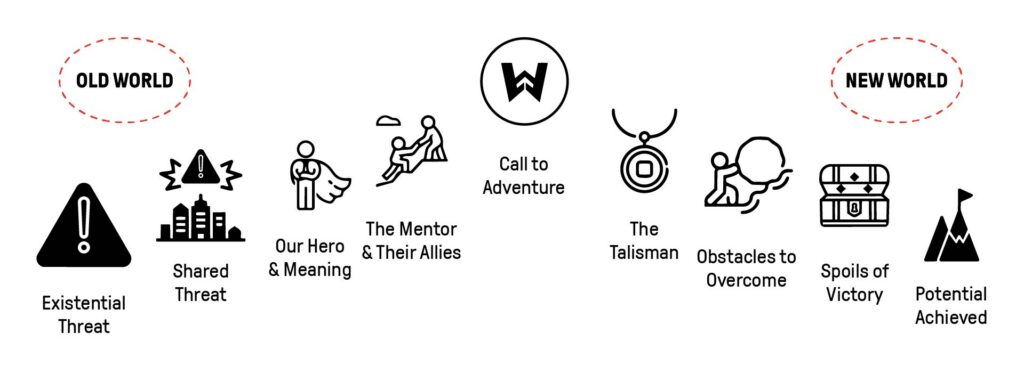
The StoryKernel delivers a complete strategic messaging architecture for B2B companies navigating complex sales cycles and multi-stakeholder buying committees. Instead of offering a self-serve copy template, Woden conducts six weeks of deep buyer and market research to craft a nine-part narrative. This process generates a master strategic messaging hierarchy that aligns sales, marketing, product, and leadership around one authoritative voice.
What separates the StoryKernel from every other framework on this list is what it produces beyond the narrative itself. The StoryKernel builds a complete Messaging Hierarchy that gives every person in the organization the precise language to describe the brand’s value at every stage of the buying journey. From that foundation, Woden builds the go-to-market motion that pulls best-fit buyers toward the business, aligning every sales conversation, every piece of content, and every customer interaction around the same story. Ongoing coaching ensures every team member can carry that story into the market with the same confidence as the founder who built it.
“To grow Revive, we had to evolve that message, expand beyond the ready buyers and jolt people into thinking differently.”
—John Luftburrow, CEO, Revive Health | Read the full case study
How It Tells Your Story
- Opens with an unavoidable shift in the market that makes the buyer’s current way of operating untenable
- Positions the customer as the hero navigating that shift and the brand as the credible guide
- Builds a nine-part narrative arc through six weeks of deep customer, competitor, and market research
- Establishes a complete strategic Messaging Hierarchy that equips revenue teams with precise, differentiated messaging for every buyer persona and funnel stage.
- Embeds the story across the organization through the Transformation Journey and StoryAccelerator coaching
- Scales the story through StoryEngine, Woden’s AI platform that eliminates Narrative Drift and keeps every output consistent with the brand’s narrative
Key Features
- Nine-part strategic narrative framework built through six weeks of deep research
- Interviews with customers, employees, competitors, partners, and investors
- Derives an actionable strategic Messaging Hierarchy directly from the narrative to power go-to-market campaigns, pitch decks, and digital content.
- Proprietary Transformation Journey change management framework that moves the organization from knowing the story to living it
- StoryAccelerator coaching that builds organization-wide storytelling capability over time
- Designed for five or more years of narrative consistency
- Backed by Woden’s guarantee: if we do not uncover what makes your brand essential, we will refund the full fee paid
- Powered by StoryEngine, Woden’s AI platform built on the StoryKernel that eliminates Narrative Drift and keeps every team member telling the same consistent story
What It Has That PitchKitchen Doesn’t
Woden’s goal is to bring every person in the organization into the story, give them the language to carry it into every conversation with a buyer, and build the internal infrastructure that makes the story compound over time.
While both agencies operate on similar timelines, Woden expands beyond internal interviews by conducting direct customer research and competitive market analysis.
The StoryKernel produces a complete Messaging Hierarchy that gives every person in the organization the precise language to describe the brand’s value at every stage of the buying journey. Every sales conversation, every piece of content, and every customer interaction pulls from the same story so the market receives a consistent signal regardless of who they spoke to or in what order.
From that foundation, Woden builds the go-to-market motion that pulls best-fit buyers toward the business rather than pushing prospects forward. This lives in the organization itself, and is carried by every team member into every conversation with the same conviction as the founder who built it.
Ongoing coaching ensures the story does not drift the moment the engagement ends. Every new hire, every new market, and every new competitive challenge gets met with the same precise narrative rather than a new interpretation of it. The story compounds over time rather than resetting with every personnel change.
For organizations that want to grow, the StoryKernel is the foundation that makes that possible.
See what Woden clients are saying on Clutch. | Connect with Woden on LinkedIn.
Andy Raskin’s Strategic Narrative
Best for: Venture-backed CEOs at growth-stage companies who need leadership-level alignment around a high-level narrative and have the internal infrastructure to translate that strategy into execution.
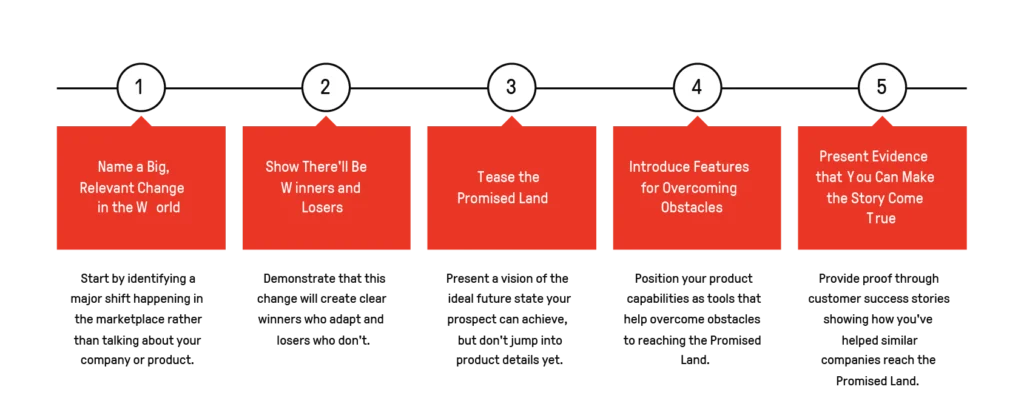
Andy Raskin is a strategic narrative consultant whose clients have included Salesforce, Gong, Dropbox, Uber, Intercom, and Square. His framework, made famous through his viral analysis of Zuora’s pitch deck, is built on the insight that great pitches do not lead with product, problem, or vision. They lead with a change in the world.
“The CEO has to be the decider. This story really is the strategy.”
—Andy Raskin | See Andy Raskin’s work
How It Builds Your Narrative and Puts It to Work
- Opens by naming a big, relevant, and undeniable shift in the buyer’s world
- Shows winners and losers to create urgency through loss aversion and desirability
- Teases a promised land that is improbable without the brand’s guidance
- Introduces features as magic gifts that help the hero overcome obstacles to the promised land
- Presents evidence last, after the story has already been believed
- Deliverable is a narrative document and alignment session with the CEO and leadership team
Key Features
- Five-step framework optimized for leadership alignment and high-stakes pitch narratives
- Deep expertise in venture-backed and enterprise-scale go-to-market narratives
- Highly selective engagement model working directly with CEOs and senior leadership
- Engagements start at $100,000 and above
- No proprietary AI platform, coaching program, or organizational execution path
Where It Falls Short
Raskin’s framework is designed for the leadership-level narrative conversation. It produces the story but not the coaching, the change management, or the AI infrastructure required to make that story live consistently across the organization. For companies where narrative consistency across every team and every customer interaction is the core challenge, Raskin’s framework stops at the point where the real work begins.
Learn more about Andy Raskin’s Strategic Narrative.
Pitchmaps

Best for: B2B companies navigating mergers or new market entries that need a narrative infrastructure aligned across every team member and every go-to-market asset.
PitchMaps is a B2B messaging system built specifically for Private Equity-backed companies selling in environments where prospects are skeptical, and solutions are complex. Built around the Cause, Villains, and Pillars, the PitchMap framework moves beyond high-level brand positioning to create a narrative infrastructure that aligns every team member around a single consistent conversation. It is built on the creative multiplier principle, which uses advertising techniques to make technical B2B messages sticky and memorable, prioritizing evidence-based research over creative guesswork.
For B2B leaders navigating major organizational changes like mergers, acquisitions, or new market entries, PitchMaps is a strong tool for producing a consistent suite of go-to-market assets quickly.
“PitchMaps helped us align our entire sales team around one story for the first time. Every rep walked into every conversation with the same language.”
—VP of Sales, B2B Technology Company | See PitchMaps
How It Tells Your Story
- Built around three narrative pieces: Cause, Villains, and Pillars
- Uses the creative multiplier principle to make complex B2B messaging memorable and repeatable
- Designed specifically for skeptical buying environments where technical solutions need to be made accessible
- Produces a consistent suite of physical go-to-market deliverables aligned to the same story
- Particularly effective for organizations going through mergers, acquisitions, or new market entries
Key Features
- Evidence-based research methodology rather than creative guesswork
- Built exclusively for B2B companies with complex products and skeptical buyers
- Strong track record with organizations navigating major structural or market changes
- Focuses on producing a full suite of consistent go-to-market assets rather than a single deliverable
- Custom pricing based on engagement scope
Where It Falls Short
PitchMaps is primarily focused on physical deliverables and the consistency of go-to-market assets. For companies that need the narrative to travel across a large organization over five or more years, maintaining that consistency requires ongoing internal governance that PitchMaps does not provide. It does not include the organizational change management, the ongoing coaching, or the AI infrastructure required to keep every team member telling the same story as the organization scales.
StoryBrand

Best for: Small businesses, early-stage companies, and brands with a straightforward product and a short sales cycle looking to establish clear, customer-centric messaging quickly.
Donald Miller introduced the StoryBrand framework in his 2017 book Building a StoryBrand. It operates on the principle that customers buy the products they can understand the fastest, and its seven-part narrative sequence has helped thousands of small businesses clean up their homepage, remove jargon, and center their messaging around the customer rather than themselves.
“StoryBrand forced us to stop talking about ourselves and finally start talking about what our customers actually care about. For a small business, that shift was significant.”
— Founder, B2B Services Company
How It Builds Your Narrative and Puts It to Work
- Follows a seven-part sequence: Character, Problem, Guide, Plan, Call to Action, Failure, and Success
- Keeps the customer as the hero and positions the brand as the guide with a clear plan
- Strips away corporate jargon and creates immediately scannable messaging
- Designed for direct application to homepages, email funnels, and landing pages
- Provides a self-serve BrandScript template teams can complete independently
Key Features
- Seven-part fill-in-the-blank BrandScript framework
- Widely available through the book, online courses, and certified guides
- Fast to deploy with immediate application to marketing collateral
- Large community of practitioners and certified StoryBrand guides
- Accessible pricing starting at $275 for the book
Where It Falls Short
StoryBrand compresses a brand’s value into its most transactional form, which works for simple products and short sales cycles but leaves the strategic value invisible for complex B2B companies with long buying processes and multi-stakeholder decisions. B2B buying decisions now involve an average of six to ten stakeholders, each arriving with different priorities and definitions of value, a complexity that a seven-part homepage template was not designed to navigate. It does not produce internal alignment across sales and marketing, does not differentiate from competitors within the story itself, and does not include the coaching or change management required to get a full organization telling the same story consistently.
Choosing the Right Framework
PitchKitchen is the right choice for founder-led B2B companies that need strategic messaging plus execution assets delivered together without building out a marketing team to manage either. For every other situation, the right alternative depends on what the organization actually needs:
SharpStance
Best for: Seed and Series A B2B startups that need lean, fast positioning and messaging before they can commit to a full narrative engagement.
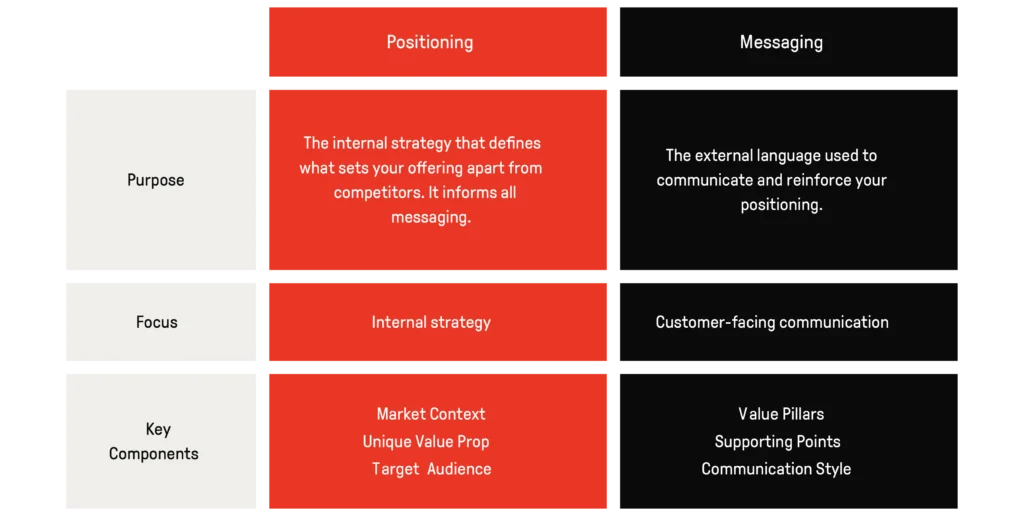
SharpStance is a positioning and messaging consultancy founded by Jenna Alburger, built specifically for seed and Series A companies that have skipped the step of clearly defining their positioning while they were busy scaling. The engagement runs through a project kickoff, two positioning workshops covering best-fit customers, real competitors, points of differentiation, value themes, ideal customer profiles, and market category. There is also a final messaging stage that turns the strategy into a homepage wireframe and an updated sales pitch.
“Jenna helped us nail our product positioning and built a clear messaging strategy for our new launch. Now it’s easier to explain our value to customers, and we’ve seen an improvement in both sales and marketing activity.“
— Richard Roy, Chief Commercial Officer, Minisoft
How It Builds Your Narrative and Puts It to Work
- Gathers stakeholders from sales, marketing, product, and customer success before any positioning work begins
- Maps best-fit customers, real competitors, and points of differentiation in a dedicated workshop
- Defines value themes, ideal customer profiles, and market categories in a second session
- Translates the finished positioning into a homepage wireframe
- Updates the sales pitch so the team can start using the new story immediately
Key Features
- Founder-led positioning and messaging consultancy built for seed and Series A B2B startups
- Three-stage engagement: kickoff, positioning workshops, messaging development
- Deliverables include a positioning framework, messaging guidelines, homepage wireframe, and updated sales pitch
- Emphasizes an outside, unbiased perspective on a founder’s own product
- Custom-quoted, project-based pricing scaled for early-stage budgets
Where It Falls Short
SharpStance is built for a single-founder or small-team decision, not a multi-stakeholder buying committee or a large, distributed organization. Its engagement model is scoped around one company at one stage. It doesn’t include the change management infrastructure a company needs once the team grows past the people who sat in the original workshops, and it isn’t designed to hold up as the single narrative for five or more years of growth.
Choosing the Right Framework
PitchKitchen is the right choice for founder-led B2B companies that need strategic messaging plus execution assets delivered together without building out a marketing team to manage either. For every other situation, the right alternative depends on what the organization actually needs:
- Leadership-level strategic narrative for a venture-backed CEO > Andy Raskin
- Simple customer-centric messaging for a small business > StoryBrand, Sharpstance
- Cause-based messaging for complex B2B sales environments, mergers, or new market entries > PitchMaps
- Strategic narrative built alongside the team paired with actionable storytelling > Woden’s StoryKernel
If you are a strategic B2B leader whose product requires the market to think differently about an existing problem, whose team is not telling a consistent story, or whose brand is losing deals to competitors with a lower price and a similar pitch, the StoryKernel is built exactly for you.
More than 300 B2B brands have used their StoryKernel to win more best-fit buyers for less. Want to see what your story could do?
Get Started: We Will Record an Analysis of Your Current Story