
MAKE YOUR STRATEGIC BRANDING OPERATIONAL
When Ben Stillwill became CEO of Streamline Health, he knew his success would be in his story. Before ascending to the corner office, Ben had spent nearly a decade building Streamline’s renowned customer experience model. He had seen first-hand the impact it had with clients, how they raved about it, and believed it was what made Streamline different.
But the story Ben believed, in the hands of others, became a generic claim of “great service.” Not only could the rest of the company not communicate that value—they didn’t even agree what it was about the service model that really made the company different.
He and his marketing lead first turned to StoryBrand. The resulting BrandScript captured a consensus view, which meant no uptake, no change, and no impact. Sales stayed flat.
A year later, when Streamline connected with Woden, Ben’s experience loomed large. The holistic, discovery-based approach to the StoryKernel offered a path to capturing the value Ben had seen.
But the most pressing question was: how will we actually effect change?
Up to 80 percent of strategic branding work fails. A narrative that pulls buyers towards your brand is step one, but if a company can’t change how people treat customers, understand the strategy, and communicate that to others, the story won’t reach its potential.
Change management must be integrated into a brand storytelling project from day one. When the strategic narrative process becomes a transformation journey that mirrors the story itself, the odds flip from 80 percent failure to 98 percent success.
TURN YOUR TEAM INTO AN ARMY OF StoryTELLERS
Most branding initiatives fail because no one designed a way to get the organization from knowing the strategy to living it. That gap is in all organizational initiatives, and is why change management exists as its own discipline. Prosci’s ADKAR model, one of the most widely adopted change management frameworks, breaks change down into five stages an individual moves through: Awareness, Desire, Knowledge, Ability, Reinforcement.
Kotter’s 8-Step Change Model takes a different angle, focused on building executive urgency and stacking early wins to create momentum. Both, and many others, point to the same truth: change only happens when there’s a clear path to get there. Streamline learned this the hard way.
The promise of the StoryKernel is transformation. But while reviewing existing change management frameworks, Woden ran into the same issue every time. They were generic, built for any kind of organizational change—mergers, software rollouts, organizational restructures—none of them were built for a narrative transformation specifically.
To enact a comprehensive messaging change, Woden needed something that mirrored the strategic narrative itself. We developed a six-phase change management framework to pull companies like Streamline through a transformation journey, aligning their teams and finally bringing change within reach.
Woden’s Transformation Journey
Effective change management must be integrated into strategic narrative development from the beginning. Woden developed its own approach—a Transformation Journey—that works alongside an engagement.
What makes Woden’s Transformation Journey so powerful is that it mirrors the StoryKernel, pulling employees into the journey seamlessly as we uncover their story. Any organization looking to engage in positioning, branding, or storytelling work should model this framework to ensure they’re in the 20 percent of companies whose branding succeeds.
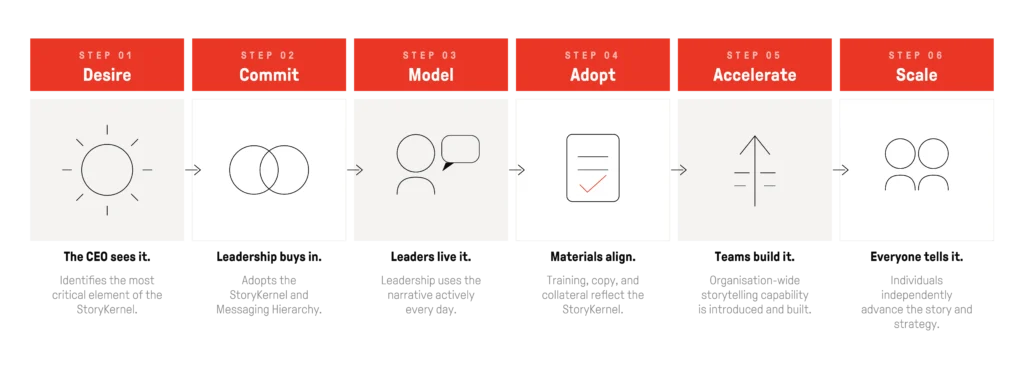
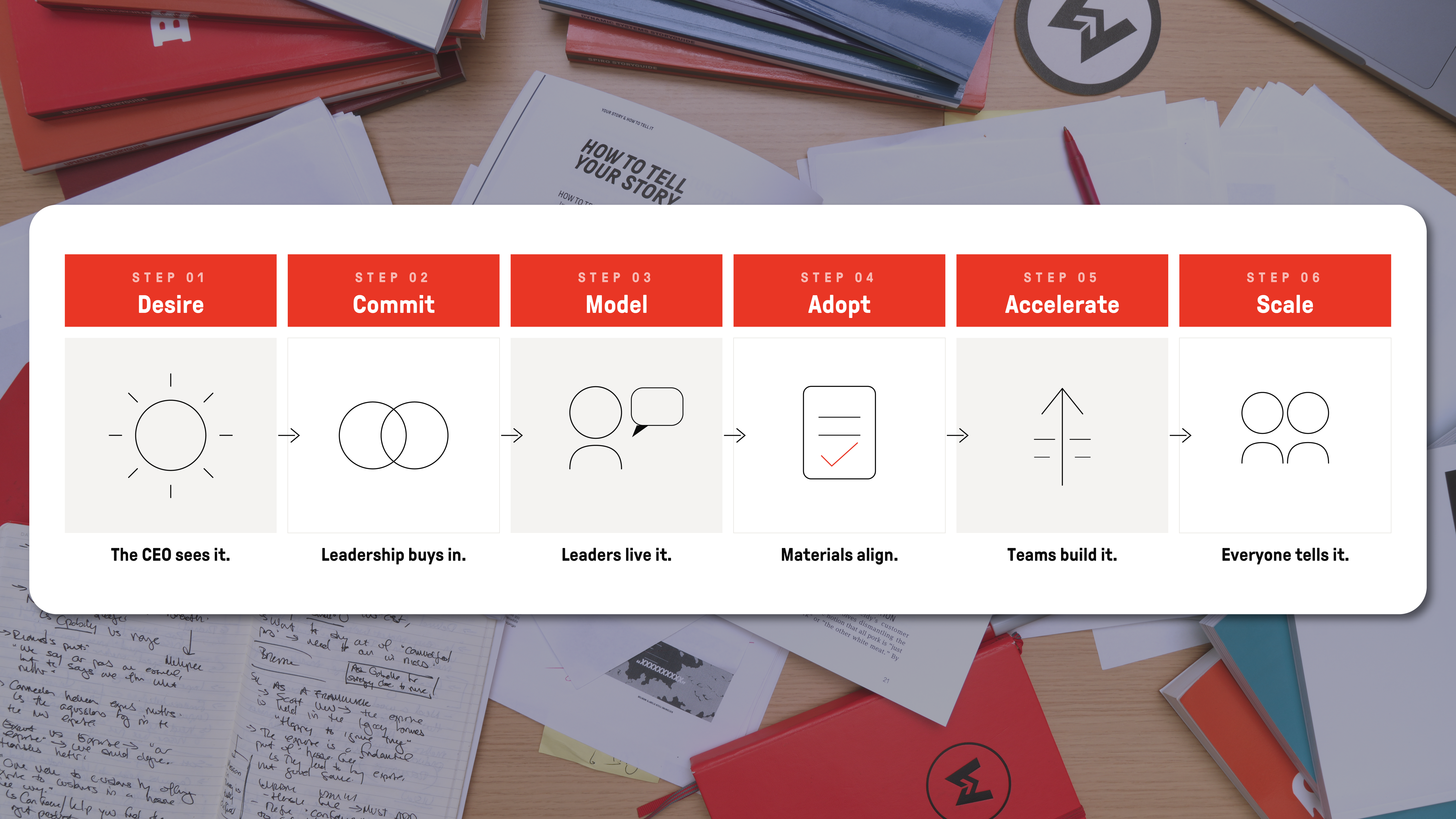
There are six phases to Woden’s Transformation Journey:
- Desire: The CEO has identified the most critical element of the StoryKernel
- Commit: Leadership has agreed to adopt the StoryKernel and Messaging Hierarchy
- Model: Leadership is actively using the narrative daily
- Adopt: Materials, training and copy are aligned with the StoryKernel
- Accelerate: Organizational-wide introduction and storytelling capability built
- Scale: Individual team members independently advance the story and strategy
These six phases work in sequence. The clearest way to view this journey is through a real organization.
When Woden started working with Revive Health, they had acquired multiple companies, and no one had a clear sense of their unified value. The CEO needed a clear, compelling story that united all parts of Revive behind a single value proposition.
Because they followed the Transformation Journey, Revive became one of Woden’s clearest examples of the Transformation Journey at work, from a CEO’s first spark of Desire to a team advancing the story entirely on its own.
1. Desire: Transformation the CEO Wants to See
The first step of enacting change is a desire for change. That has to start at the top.
Revive’s CEO John Lufburrow saw what he wanted in his StoryKernel delivery. The Revive story was built to emphasize high utilization of its plans. When he saw this new way of going to market, that the best benefit plan is the one that employees want to use, he immediately shared this belief with his 300-plus employees at a town hall.
His StoryKernel put into tangible language what he always believed to be true. For a story to gain traction in an organization, every CEO must be struck in the same way. Desire demands one part of the story so essential that the company won’t be able to reach its goals without it.
When the CEO can articulate the specific change their StoryKernel makes for their company’s strategy, they have a clear reason for transformation. It could be a new buyer, a change in positioning, or something else.
For real transformation to occur, it is imperative that the CEO moves beyond the reasons they engaged in a strategic narrative project to begin with. They must see the specific change they want in the story, believe it ties to organizational strategy and goals, and to be able to point to where the StoryKernel articulates that intended change.
Woden requires Desire before advancing beyond the StoryKernel to additional collaborative work in its projects.
2. Commit: Buy-in from Leadership
The CEO sets the direction of the organization, but change requires the rest of the leadership team to be equally invested in success.
Revive’s go-to-market team was eager for a way to differentiate from competitors. The StoryKernel had been developed with their input through interviews, so the CEO’s endorsement of it gave everyone energy about the path forward.
To generate Commitment with the leadership team, Woden helped them co-create their Messaging Hierarchy from the StoryKernel. This created alignment on key language they would need to share their story with the market and their teams.
As a group, they signed off a narrative strategy to implement the StoryKernel, Mission, Brand Promise, Positioning and more. Set goals, milestones and timelines for each, and accountability across the team resulted in a commitment to enact transformation, and provided a clear plan for how to do it.
The Commit phase forces stakeholdering that ensures the entire leadership team is fully committed to achieving transformation. In the Commit phase the story moves from pure strategy to set goals that must be accomplished.
Woden asks teams to Commit to a unanimous signoff on a narrative strategy immediately following the StorySeminar.
3. Model: Showing Others the Story’s Potential
To motivate transformation across the organization, leadership must show others how to tell the story and demonstrate success using it.
Revive’s CEO had started telling their new story within minutes. From that first town hall, he embraced their messaging at every touchpoint: at conferences, on podcasts, in LinkedIn content, and even writing his own personal version of the StoryKernel.
The rest of the leadership team chose a more structured approach to modeling the story. Adam Knox, Revive’s CRO, brought together leaders from marketing, CX, and sales to model the story in full at a Sales Kick Off.
Leadership shared success stories from client interactions where they used the StoryKernel, and demonstrated role playing and their own messaging to show others how to tell the story as intended.
Before asking others to change, leadership must Model that they are excited to take on transformation themselves. The Model phase helps leadership be accountable to the story, and provide a best practice for their teams.
Woden challenges leadership teams to begin Modeling while the StoryGuide is in development.
4. Adopt: Aligning the Organization with the Story
A strategic narrative is highly visible across the organization. Expanding transformation beyond requires updating collateral, training and cultural materials, and more to be consistent with the StoryKernel.
When the Revive team received their first batch of StoryGuides, they ordered more within days. Head of Marketing Anthony Brown and Senior VP of Customer Success Robin Handy went to work with their teams updating the Revive website, adding a new video built around the narrative, building out new talk tracks, and creating product marketing collateral to reinforce the story at key touchpoints.
These visible changes serve a dual role in the Adopt phase. It demonstrates the commitment the leadership team has to the entire organization, while providing resources and support to team members when they are asked to use the story themselves.
Once these changes are made, leaders introduce their teams to the StoryKernel, and how that story impacts their role. These sessions must be delivered by a team’s leadership (versus HR or training), and are ideally baked into the existing meeting cadence to demonstrate the story as a core part of their role.
The first goals of StoryAccelerator are devoted to the Adopt phase.
5. Accelerate: Building Organizational-Wide Storytelling Capability
Brands that achieve the potential captured in their StoryKernel transform every employee into a storyteller.
Revive’s more than 300 employees engage daily with thousands of customers, millions of members and hundreds of potential customers. For each of these people to see the brand’s value the way CEO John Lufburrow does, storytelling had to become a core capability.
The sales, customer success, and marketing teams have made sharing success with the story a key element of their meeting cadences. Continued practice on how the story pulls in best-fit buyers, and how to get the right message to the ideal buyer at the perfect time has already delivered results:
Revive’s evolution from a point solution to “whole person care” is captured in the StoryKernel, and telling that story has already resulted in positive changes to how deals are positioned with potential clients.
The Accelerate phase still requires hands-on support from leadership. To become strong storytellers, people need a constant feedback loop from clients and from leadership to understand what’s resonating, what’s consistent, and where to grow. It is important in this phase to highlight wins and successes.
This Accelerate phase is complete when the team is independently telling the story consistently and in a way that pulls new buyers towards the brand.
6. Scale: An Entire Team of Empowered Storytellers
When the story begins to Scale, transformation has become an ongoing part of the business. A brand’s narrative evolves alongside its customers, and organizations that successfully implement theirs empower their entire team to advance the story consistent with the strategy.
The Revive team has started using StoryEngine, an AI tool provided to all Woden clients, to get strategic feedback on content and go-to-market strategies. With this access to a storyteller on-demand, the team is independently advancing conversations with prospects, customers, and internal stakeholders that reflect the company’s narrative.
The Scale phase is perpetual, when the team is self-reliant and growing their storytelling abilities. They’re seeing tangible returns from the application of their narrative, and those returns reinforce the behavior.
Not Just the Story, But How You Tell It
Five years ago, Woden was engaged by an innovative SaaS company. Like Streamline, the brand leaned on service as a differentiator. And, like Streamline, they developed a StoryKernel that captured the CEO’s vision.
That transformation was never realized.
It doesn’t matter if a brand has the ideal message if the team isn’t bought in to making it a reality. That’s why so many great branding projects fail, and why a clear change management plan is as essential to their success as the underlying work itself.
Woden’s Transformation Journey is designed to create that change alongside the development of the narrative. Each sequential phase moves your organization from leadership alignment to company-wide ownership of the narrative, so the story your buyers need to hear reaches them at every touchpoint.
When your team internalizes their strategic narrative, they pull in best-fit buyers and deliver clear value to every customer.
Frequently Asked Questions
Most B2B brands try to differentiate on features, service quality, or price, and end up sounding identical to every competitor in their market. Real differentiation comes from owning a precise point of view about what is shifting in your market and why your brand is the only credible guide through that shift. When that point of view is captured in a strategic narrative, it becomes impossible for a competitor to replicate because it is rooted in the authentic beliefs, customer relationships, and market understanding only your brand possesses.
The StoryKernel uncovers that differentiation through deep research into your customers, competitors, and market and builds it into a story every team member can carry into every conversation, making your brand’s position in the market something buyers feel before a single feature is discussed.

A brand story becomes the foundation for everything your company communicates. Your sales team uses it to open conversations with the market shift your buyer is already living through rather than a feature list. Your marketing team uses it to produce content that pulls best-fit buyers toward the business at every stage of the journey.
Your leadership team uses it to align new hires, inform strategic decisions, and give every person in the organization the same language to describe why the company matters. When a brand story is built into the StoryKernel, it also becomes the context layer that powers AI tools like StoryEngine to produce on-brand content at scale.
Standing out in a crowded B2B market requires owning a point of view so specific that a competitor cannot replicate it without becoming a different company. Most brands try to stand out by describing their features better, designing a more striking website, or producing more content.
None of these produce differentiation because they are all execution-level decisions layered on top of a story that sounds like everyone else. Real differentiation comes from the StoryKernel’s Existential Threat, a precise articulation of the market shift the brand was built to address, and the Obstacles to Overcome stage, where the brand’s unique capabilities are positioned as the specific answer to that shift rather than a list of features.
Learn how the StoryKernel builds differentiation into the story itself.