

Every leap in model capability unlocks a new way AI impacts business. But for everything Claude Code can build or that Gemini can scrape from your Google Drive, one thing is missing: context.
The most capable model still does not understand strategy and vision like the CEO. None benefit from the experiences and perspectives of people who built the brand. And even a model that ingests every chat and call transcript lacks the taste to know what is essential.
This context can be trained into AI painstakingly through reinforcement or manual preparation of training data. Even then, so much of an organization’s knowledge remains human and inaccessible. A single employee training their Claude, for example, is still only giving the AI a fraction of the context it requires. And if they don’t fully understand the company’s story and strategy themselves, it creates misalignment at scale.
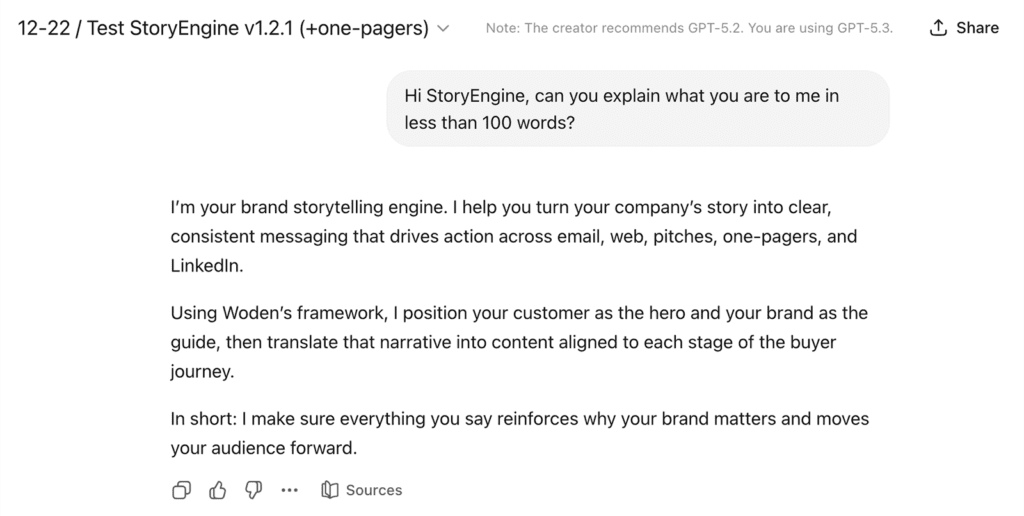
Six months ago, Woden launched our first AI offering, StoryEngine. Our clients have rapidly embraced it: weekly usage (per client) has grown between 5 and 14 percent each week for the past six months.
This growth in usage happened as StoryEngine evolved from a content generation tool to a strategic partner and storyteller in many of our clients. StoryEngine is being used by one company to develop an “ethos” that guides their 1,300 employees. Another has used it to create strategic alignment across a dozen companies in their portfolio.
Strategic narrative is the context layer AI is missing.
We’re excited to share our vision for storytelling at scale: an entirely revamped digital StoryGuide with an embedded, new version of StoryEngine that puts an expert storyteller at our clients’ fingertips.
Use Your Story as a Context Layer
For a decade, Woden’s clients have asked us to uncover the story within their brand and shape it into their StoryKernel.
The StoryKernel already works as a human context layer for Woden’s clients. We conduct dozens of interviews, review reams of internal documents, and go deep on market and competitive research. The resulting 400-word narrative makes the key creative and strategy decisions required to distill a brand to its most essential elements.
We derive the Messaging Hierarchy from it and have a defined methodology for how these stories are told across the buying journey. The StoryGuide is a blueprint for aligning everything in the company behind the strategic narrative. The decisions on what to include in the StoryGuide and content created for it are the context people need to execute the organization’s strategy. And for our clients, it works.
Woden’s storytelling framework is structured and designed relationally: a conversation with a buyer at a given funnel stage is designed around taking the relevant section of the StoryKernel, reframing it to the specific buyer, and applying it to the use case at hand.
This knowledgebase, its underlying strategic decisions, and the defined way to use the StoryKernel is the exact context that AI needs. The first version of StoryEngine showed us that Woden’s storytelling framework is already designed in the exact way a model wants to ingest and use information.
StoryEngine 1.0: How To Improve An AI Model
Woden first began offering storytelling AI prompts to clients in July 2024. These were text files that clients copied into their own ChatGPT. The prompting strategies were helpful but limited.
15 months later we launched the first StoryEngine as a pilot. We trained a custom GPT for each client, and developed baseline training for ChatGPT on Woden’s methodology. StoryEngine 1.0 has been well-received, but was still designed primarily for marketing and sales enablement outputs.
As the product has gained adoption, Woden has learned three key things:
- Refining our IP: Woden’s methodology has been refined and developed since 2014. Not enough of it had been codified, so the early StoryEngine versions trained on similar approaches. In the past six months, we have tightened the IP around the StoryKernel, Messaging Hierarchy, and story-driven customer journey. As a result, newer versions of StoryEngine produce better outputs with more defined training.
- Model Capability: The first StoryEngine included training from Woden on specific deliverables (such as cold emails). New capabilities were released every few weeks. But as the underlying AI models improved, this training became less relevant. Our training emphasis has shifted away from writing the “best” cold email or talk track, and instead to training the AI on how to apply the IP to use cases it already understands.
- Expanded Use Cases: Clients have done more with the AI than expected. We initially expected StoryEngine to largely be output driven, but turned out the guardrails we trained into it were not needed. Its understanding of the StoryKernel has helped our clients strategize and ideate in ways we had not anticipated. One client has even used their StoryEngine to onboard employees by immersing them in the culture, strategy, and teaching them to share the company’s story.
We’ve also learned our clients are eager to get out of the ChatGPT ecosystem. Most have switched to Claude. They need ways to share the StoryEngine with more people on their team outside of direct login to ChatGPT.
The New Digital StoryGuide and StoryEngine 2.0
In the past month, we tore down the StoryGuide and rebuilt it as an AI-first product. The new version of the StoryGuide is primarily digital: every client receives a private, wiki-style website with their StoryGuide content.
The StoryGuide is still designed around the customer journey to ensure our clients deliver the right message to the ideal buyer at the perfect time.
StoryEngine is embedded into each digital StoryGuide; clients login and engage directly with the AI inside of their StoryGuide. The digital format allows our clients to add new content such as product details or internal strategy documents that StoryEngine understands and integrates into its outputs through the lens of the story.
The design of content within the StoryGuide has evolved to make the AI more capable. The mapping of the story across the buying journey now contains structured context for how the StoryKernel was applied to each stage. The same context is provided for the narrative applications (personas, product messaging, customer stories).
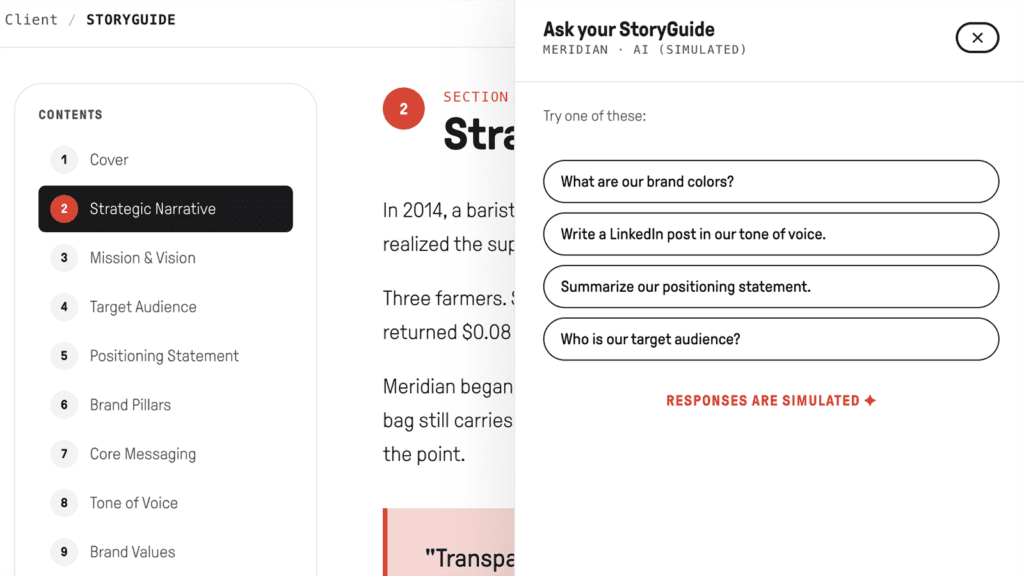
StoryEngine understands Woden’s methodology. The integration with StoryGuide and the content design in it allows the AI to reference content and create applications consistent with the context of the overall story.
A detailed voice and tone guide and edited interview transcripts have been integrated into the StoryGuide to ensure StoryEngine generates outputs in the voice of the client,— and can even reference specific stories or anecdotes in the brand’s own language.
The underlying design of the StoryEngine optimizes compute through prompt structure and caching, which reduces costs below an internally-built model.
What’s Next
StoryEngine 1.0 offered strong marketing and sales outputs. Our boldest clients embraced it for strategy.
The digital StoryGuide and Claude version of StoryEngine is deep in development under the leadership of our Director of Storytelling, GianPaolo Guercio. All existing clients will migrate to the digital StoryGuide and new StoryEngine in June 2026.
This is an exciting step forward for our clients and unlocks new potential in how they use their StoryKernel. But it’s still just the beginning.
The context layer provided by the StoryGuide is needed across all AI applications in a brand. As StoryEngine develops and our clients embrace AI in new ways, we see the API behind StoryEngine as a way to align different models: automated customer interactions that know how to tell the right story, AI-generated video that appreciates the audience its speaking to, and custom applications that understand both the job to be done—and how it fits within the company’s broader strategy.
The right story is more powerful and valuable than ever.