

Why Your Go-To-Market Strategy Is Only as Strong as Your Brand Story
Why does your business need a storytelling framework?
A great go-to-market strategy is fundamentally anchored in storytelling. In a saturated digital economy, a clear brand story forges the psychological bonds necessary to engage your customer. Selecting and executing the correct framework ensures your value is understood by your target market.
While the entertainment industry utilizes these structures to captivate audiences, business leaders use them to create powerful messaging and positioning. By adopting the right storytelling framework, you craft high-impact content that pull high-intent buyers toward your brand. When a story is deployed consistently across every part of an organization, from sales, marketing, and internal operations, it creates a powerful bond that is easy for your target audience to grasp.
Stories take complex ideas and make them simple, understandable, and actionable. If buyers struggle to understand your product a storytelling framework provides the context they need to recognize your value without your experience. These frameworks facilitate ownership. When a prospect can easily retell your story, it becomes their own. Brands who understand and share their story gain more than customers—they create evangelists.
To help you achieve this level of market influence, we have outlined nine essential frameworks that define modern business storytelling.
Jump To YoUr Favorite Framework
1. The Hero’s Journey
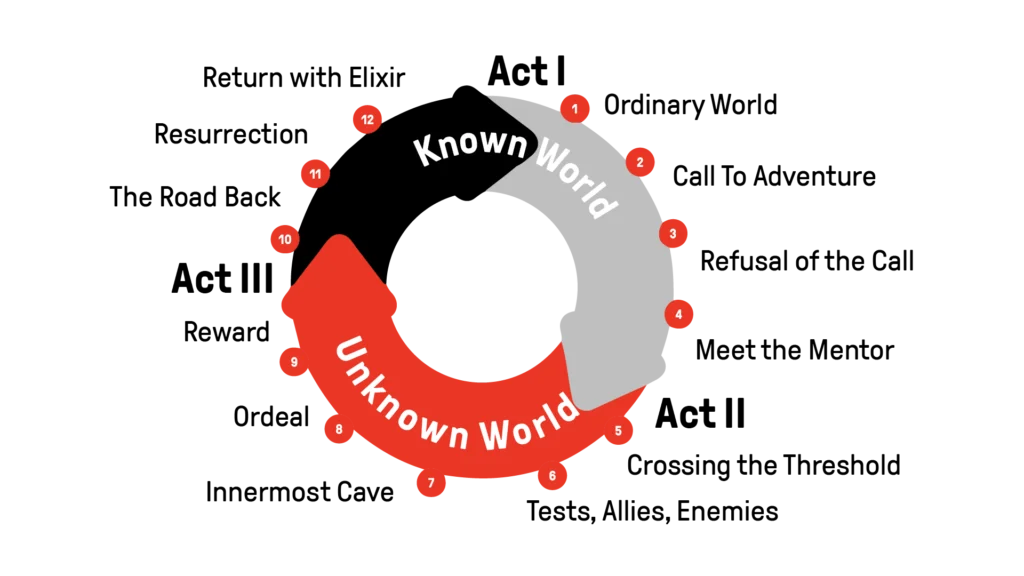
Often hailed as the grandaddy of storytelling devices, the Hero’s Journey provides the universal blueprint upon which almost every modern narrative framework is built. Popularized by Joseph Campbell in his seminal work, The Hero with a Thousand Faces, this structure is also known as the Monomyth.
The Hero’s Journey suggests that a single, fundamental narrative pattern exists across all cultures and eras, from ancient mythology and Star Wars to the most compelling brand origin stories. At its core, it follows a protagonist who is pulled from their ordinary world, forced to navigate significant trials, and ultimately returns transformed, equipped with a newfound perspective or “elixir” to share with their community.
This journey is divided into three major acts: the Separation (Act I), where the hero hears a call to adventure; the Initiation (Act II), where they face the supreme ordeal; and the Return (Act III), where they integrate their growth into their original environment
Whether a brand is positioning the customer as the hero or recounting its own founding myth, the power of the Hero’s Journey lies in its ability to reframe technical abilities as the result of hard won experience. However, it is important to note that while this remains the definitive method for high level storytelling, it is often less effective for direct business applications.
How The Hero’s Journey Framework works
Leaving Home (Act 1)
- The Ordinary World: Describe the hero’s everyday life before anything happens.
- The Call to Adventure: A problem pops up that forces the hero to leave their comfort zone.
- Refusal to the Call: The hero is scared to change.
- Meet the Mentor: The hero meets someone who gives them the courage or the tools to start.
The Struggle (Act 2)
- Crossing the Threshold: The hero officially starts their journey.
- Tests, Allies, Enemies: The hero faces small setbacks and meets people who either help or hinder them.
- Innermost Cave: The hero gets ready for their toughest challenge yet.
- The Ordeal: This is the “make or break” moment where the hero faces their biggest fear or obstacle.
- The Reward: The hero survives the crisis and realizes they have what it takes to succeed.
The Return (Act 3)
- The Road Back: The hero heads home, but they still have to deal with the “aftershocks” of their big battle.
- The Resurrection: The hero emerges stronger, smarter, or better than before.
- Return With Elixir: The hero returns to their old life but with a fresh perspective and a “prize” to share with everyone else.
Why It Works
- It’s an arc that’s stood the test of time.
- The arc makes the hero relatable and success hard-won
- Can be used in almost any storytelling application
Where It Falls Short
- Esoteric and hard to connect to your brand
- Lacks concrete applications for sales and marketing
- Difficult to connect to strategy
Who is The Hero’s Journey right for?
If your brand has a die-hard mythologist, the Hero’s Journey is for you.
2. The StoryKernel

The StoryKernel is a strategic narrative framework developed by Woden. It is a customer-centric storytelling framework: they are the hero of the story. When a brand sounds the same as its competitors or is too complex for people to understand easily, the StoryKernel clarifies value through a “story of change.”
At the center of each StoryKernel is a defined viewpoint about how the world is changing, and why the status quo is no longer tenable. The customer is the hero of the StoryKernel, and the arc shows how a brand guides them from the “old world” they reside in today to a “new world” where their potential is achieved.
As a strategic narrative, the StoryKernel is designed to bring a brand to key points of decision about its market, its buyer, and its own value. The framing of the StoryKernel creates strong cost of inaction bookended with clear ROI, which pulls buyers through the story and towards the brand when retold.
Each StoryKernel is a framework that maps on to all the other stories the brand shares. The stages of the StoryKernel mirror the customer journey: when it is used by a brand, it results in consistent messaging, an aligned team, and storytelling that drives buyers to action.
How The StoryKernel Framework works
1. The Existential Threat: Identifies the massive, external shift in the market that makes the “old way” of doing things impossible. It is not the customer’s fault that the world changed, but they must address it to survive. This stage defines the market-defining challenge that creates an urgent need for change.
2. The Shared Thread: Establishes why the customer must act now by connecting their success to this market shift. This stage defines the stakes and the cost of doing nothing, pulling the buyer out of complacency and into the narrative to consider a new direction.
3. The Hero: Defines the specific customer. In this framework, the story is entirely customer-centric, focusing on their roles, experiences, and challenges. By making a single person the hero, you build the empathy and trust necessary for the buyer to visualize your help.
4. The Mentor: The brand enters the story here. This demonstrates your credibility through unique technology, experience, or shared values. Your role is not to save the hero, but to provide the guidance and tools they need to unlock their own internal strength.
5. The Call To Adventure: This is the call to action where you invite the hero to join you in resolving the threats they face. You show them the path from their current disruption to a state of renewed potential, making the transition feel like an authentic, earned quest.
6. The Talisman: This is your actual product or service. It is the “magical” tool that represents your values and makes the impossible possible for the buyer. It captures the essential features and ideals that allow the hero to self-actualize.
7. Obstacles to Overcome: Shows exactly how your product is different from the competition. Demonstrates how the hero uses your “talisman” to defeat specific challenges, proving that your offering is the only one capable of impacting real change in their business.
8. Spoils of Victory: Describes the immediate rewards of the journey. This highlights the tangible benefits and victories the customer achieves once they have successfully utilized your solution to overcome their specific market obstacles.
9. Potential Achieved: The narrative comes full circle. Showing the buyer what it looks like to thrive in the “New World” on the other side of the shift. The story ends with the hero reaching their highest potential and fully realizing a new, successful reality.
Why It Works
- Creates strong cost of inaction
- Defines your ideal customer profile (ICP) and focuses the story on them
- Used across all storytelling applications
- Clarifies strategy through a defined viewpoint for the brand
- Used holistically to align people and go-to-market
Where It Falls Short
- Demands total organizational buy-in
- Requires collaboration to uncover the brand’s value
- Brand needs product-market fit first
Who is the StoryKernel right for?
B2B brands who sound the same as their competitors, have a complex product, or a misaligned team are ideal for the StoryKernel.
3. The StoryBrand (SB7) Framework

The StoryBrand (SB7) framework is a storytelling approach created by Donald Miller for his book Building a StoryBrand. It operates on the principle that customers do not buy the best products but the ones they can understand the fastest. This framework focuses on clarifying the brand message by removing noise and ensuring the customer remains the central figure of the story.
For small businesses and growing brands, this framework provides an accessible way to organize a value proposition. It helps teams identify the core conflict a customer faces and positions the brand as the essential guide with a clear solution. It is useful for building websites, landing pages, and direct response marketing assets.
How The StoryBrand Framework Works
A Character: Identifies the customer as the hero of the story who wants something specific. This forces the brand to define exactly what the buyer is looking to achieve.
With a Problem: Defines the external, internal, and philosophical challenges standing in the hero’s way. This helps the brand speak directly to the frustration the customer feels.
Meets a Guide: Introduces the brand as the mentor who possesses both empathy and authority. The brand shows it understands the hero’s pain and has the expertise to solve it.
Who Gives Them a Plan: Outlines a simple three or four step path the customer can take to move forward. This reduces the perceived risk and makes the next steps feel manageable.
And Calls Them to Action: Issues a clear and direct request for the customer to make a purchase or engage. This step ensures the story has a defined purpose and a way to progress.
That Helps Them Avoid Failure: Explains the negative consequences that will occur if the customer does not take action. This clarifies the stakes of the story and creates a sense of urgency.
And Ends in Success: Visualizes the positive transformation and the specific benefits the customer will enjoy. This gives the audience a clear picture of what life looks like after the problem is solved.
Why It Works
- It is highly accessible and easy for non-writers to implement quickly.
- It ensures the brand remains the guide while the customer stays the hero.
- There are many local StoryBrand “guides” to help small businesses.
Where It Falls Short
- Exclusively focused on marketing.
- All inputs are provided by the company.
- Doesn’t work for brands that fit the SB7 formula.
Who is the StoryBrand Framework Right for?
Smaller brands looking to refocus their marketing and generate quick leads without significant investment do well with StoryBrand.
4. Winning The Story Wars
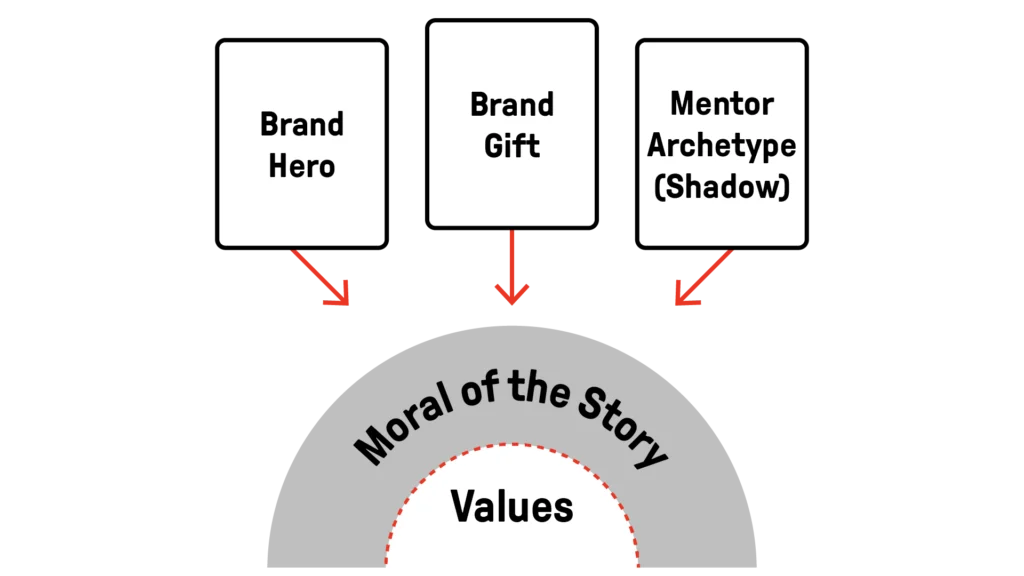
Jonah Sachs’ influential work Winning the Story Wars provides a framework for the “digitorial” age, where traditional broadcast marketing focused on creating feelings of inadequacy. Sachs argues that the era of “damsel in distress” marketing is over. In its place, he proposes a mythic, empowerment-based approach where the brand stops trying to be the hero and instead earns its place as the mentor.
This framework is designed for brands that want to build deep, values-driven connections with their audience. By moving away from fear-based tactics and toward narratives that champion higher human ideals like justice, community, and truth, brands can move beyond simple consumption and inspire actual advocacy. It is a transition from “Old Mythmaking,” where the brand is the savior, to “New Mythmaking,” where the brand provides the “magical gift” that allows the customer to triumph.
How The Story WArs Framework works
The Audience as the Hero: In this framework, the brand explicitly relinquishes the spotlight. The consumer is the hero embarking on a journey to solve a personal or societal problem. By centering the story on the customer’s potential, the brand creates an immediate bond based on empowerment rather than deficiency.
The Brand as the Mentor: The brand enters the narrative not as the conqueror, but as the wise guide. Like a mentor in a classic myth, the brand’s role is to provide the “magic gift”—the product or service—that bestows the hero with the power they need to overcome their struggles and create change.
Empowerment Over Inadequacy: This stage replaces traditional marketing’s “you aren’t enough” message with an “inspired action” message. The story must affirm the hero’s existing strengths and show how they can use the brand’s tools to reach their full potential, creating a sense of capability and hope.
The Five “P”s of Storytelling: To ensure a narrative resonates, it must be structured around five pillars: it must be People-focused, Place-centric (grounded in a specific world), Packed with emotion, Positioned in time, and Perpetual (part of a larger, ongoing saga). This creates a story that feels lived-in and real.
The World-Building Lesson: Every story must be immersive, developing a consistent world that offers valuable lessons to the hero. This world-building allows the brand to illustrate the “New Myth” it is trying to create, making the transition from the old way of thinking to a new, empowered state feel tangible.
The Hero’s Victory: The story concludes with the audience winning. By using the brand’s “magic gift” and following the mentor’s guidance, the hero achieves their goal and realizes their values. This victory transforms the customer from a passive buyer into an active evangelist for the brand’s mission
Why It Works
- Builds powerful, values-driven loyalty.
- Perfectly suited for the modern, skeptical consumer who values brand authenticity.
- A great guide to making powerful video content.
Where It Falls Short
- Primarily focuses on marketing.
- Requires a lot of self inputs from the brand.
- Provides an abstract guide that is hard to follow.
Who is Winning The Story Wars right for?
Purpose- or cause-driven brands looking to create memorable marketing campaigns can use Jonah Sach’s framework, especially with video.
5. The Story Circle
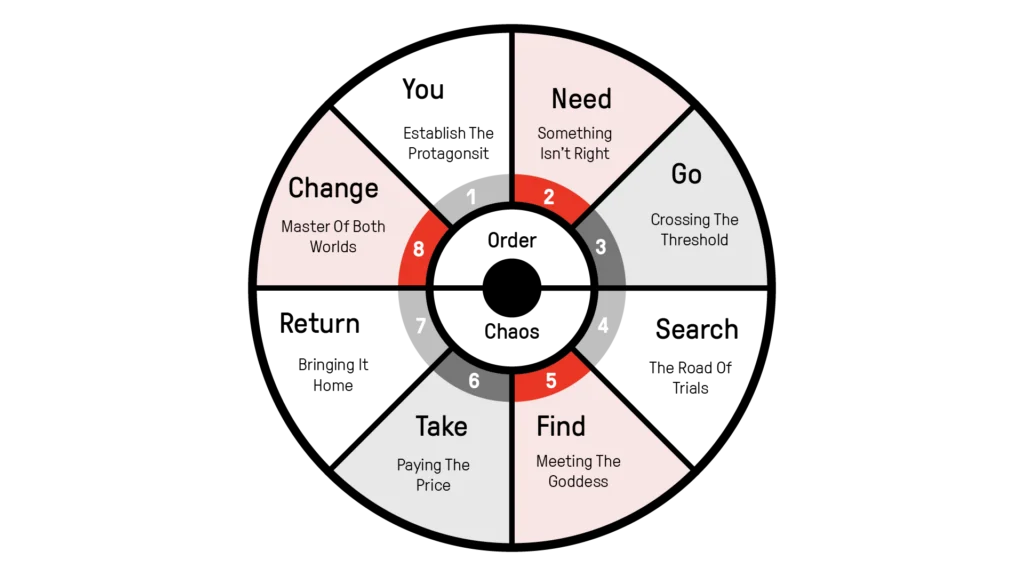
The Story Circle is a reframed version of the Hero’s Journey popularized by screenwriter Dan Harmon. It functions as a recurring eight-step loop designed to create a sense of balance and inevitability in a story. While it is widely used in the entertainment industry to plot television episodes and films, it serves as a structural guide for building characters who grow through repeated cycles of desire and change.
For business leaders, this framework provides a clear path for exploring the internal motivations of a customer. It helps brands identify the specific moment a buyer moves from a state of comfort to a state of need. This approach is particularly effective for social media content, short-form video, and narratives that focus on a single person’s emotional evolution.
How The Story Circle Framework works
You: Establishes the starting point where the hero feels safe. In a business context, this represents the customer’s status quo before they realize a problem exists.
Need: Introduces a desire or a need that pulls the hero away from their comfort zone. This is the moment a prospect recognizes a gap between where they are and where they want to be.
Go: Forces the hero to adapt to a new environment or challenge. For a buyer, this involves searching for solutions and engaging with unfamiliar products or vendors.
Search: Shows the hero learning the rules of the new world and finding their way. This represents the customer trial period or the initial implementation of a new service.
Find: Delivers the goal the hero set out to achieve. The customer successfully utilizes the product to solve their initial problem or satisfy their desire.
Take: Reveals the cost of the victory or the difficulty of the journey. In business, this highlights the effort of change or the trade-offs required to reach a new level of performance.
Return: Brings the hero back to their starting point but with the journey complete. The customer settles back into a routine now that the immediate crisis is resolved.
Change: Describes the transformation the hero experienced during the cycle. The customer is now more capable or knowledgeable because of their interaction with your brand.
Why It Works
- Easy to remember and apply to short pieces of content.
- Works well for stories that need to show personal evolution in a short timeframe.
- Able to tell different stories with the same desire of growth and change.
Where It Falls Short
- No transformation or change.
- Primarily focused on B2C brands.
- Hard to create long-form content that shows a dramatic change.
Who is the Story Circle Framework right for?
B2C brands who want to tell short stories that connect with customers while not challenging them should use the Story Circle. Also, fans of Rick and Morty or Community.
6. Pitchmaps

The PitchMap framework is a B2B messaging system developed by the consultancy PitchMaps. The PitchMap is designed for selling environments where prospects are skeptical and solutions are complex. It moves beyond high level brand positioning to create a narrative infrastructure that aligns every colleague around a single consistent conversation.
For B2B leaders, this framework is a strategic tool for navigating major organizational changes like mergers or new market entries. It is built on the creative multiplier principle which uses advertising techniques to make technical B2B messages sticky and memorable. By prioritizing evidence based research over creative guesswork, the PitchMap ensures the resulting story works for a sales professional sitting across the table from a skeptical buyer.
how The Pitchmaps Framework works
Cause: Defines the fundamental purpose and belief that drives the organization. This is the big idea that the company stands for and the positive change it seeks to create in the market. It provides the emotional and strategic foundation for why the brand exists beyond just making a profit.
Villains: Identifies the specific obstacles, outdated practices, or market forces that prevent the hero from succeeding. By naming the villains, the brand creates a clear enemy for the customer to rally against. This sharpens the conflict and makes the need for a solution feel more urgent and necessary.
Pillars: Establishes the core strengths and unique capabilities that the brand uses to defeat the villains. These are the strategic foundations of the solution that prove the brand can deliver on its promise. They provide the logical evidence and structural support needed to back up the overarching cause.
Why It Works
- Translates the complexities of a B2B brand.
- Makes technical products memorable and easy to understand.
- Designed with companies going through M&A in mind.
Where It Falls Short
- Only works for B2B.
- Focuses on physical deliverables.
- Maintaining consistency requires ongoing internal governance.
Who is the Pitchmaps framework right for?
PitchMaps primarily is used by B2B brands who need a suite of go-to-market assets that are consistent with the same story.
7. Golden Circle
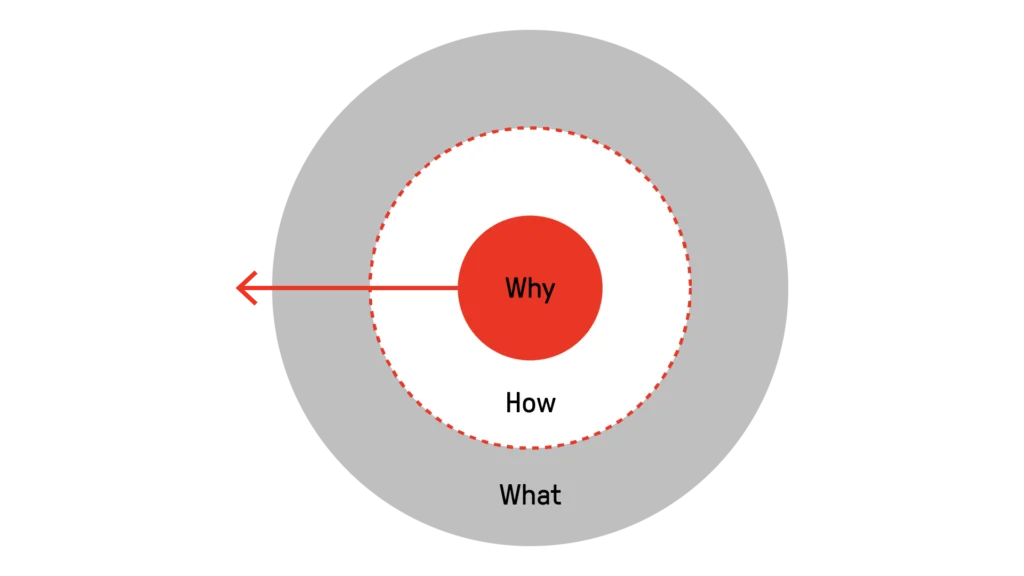
The Golden Circle is a strategic framework developed by Simon Sinek that challenges organizations to communicate from the inside out. It is based on the biological reality that humans make decisions in the limbic system, the part of the brain responsible for feelings and trust. Sinek argues that while most companies communicate what they do, the most influential leaders and brands start by articulating why they exist.
For business leaders, this framework is a powerful tool for establishing a sense of purpose that transcends the products being sold. It helps organizations attract both employees and customers who share their fundamental beliefs. By anchoring the brand in a core purpose, the Golden Circle creates a foundation for long term loyalty and differentiates the company from competitors who focus only on features or price.
How The Golden Circle Framework works
Why: Defines the core belief or purpose of the organization. This is the specific reason the company exists and the contribution it makes to the world. It is the emotional center of the brand that explains why the work matters beyond the pursuit of profit.
How: Explains the specific actions or proprietary processes that set the brand apart from others. This stage identifies the unique value proposition and the guiding principles the company uses to realize its purpose. It serves as the bridge between a belief and a product.
What: Describes the tangible products or services the company provides to the market. This is the most visible part of the business and functions as the proof of the underlying purpose. While it is necessary for the transaction, it is the result of the story rather than the start.
Why It Works
- Anchors a brand in an authentic purpose.
- Builds deep emotional loyalty that is resistant to price pressure.
- Unifies differing products under one central mission.
Where It Falls Short
- Lacks the tactical steps required to manage complex technical sales objections.
- Struggles to gain traction in highly transactional markets.
Who is the Golden Circle Framework right for?
If you think the best place for your brand is on a TED Talk stage—if only you could name your purpose—lean into the Golden Circle.
8. Freytag’s Pyramid
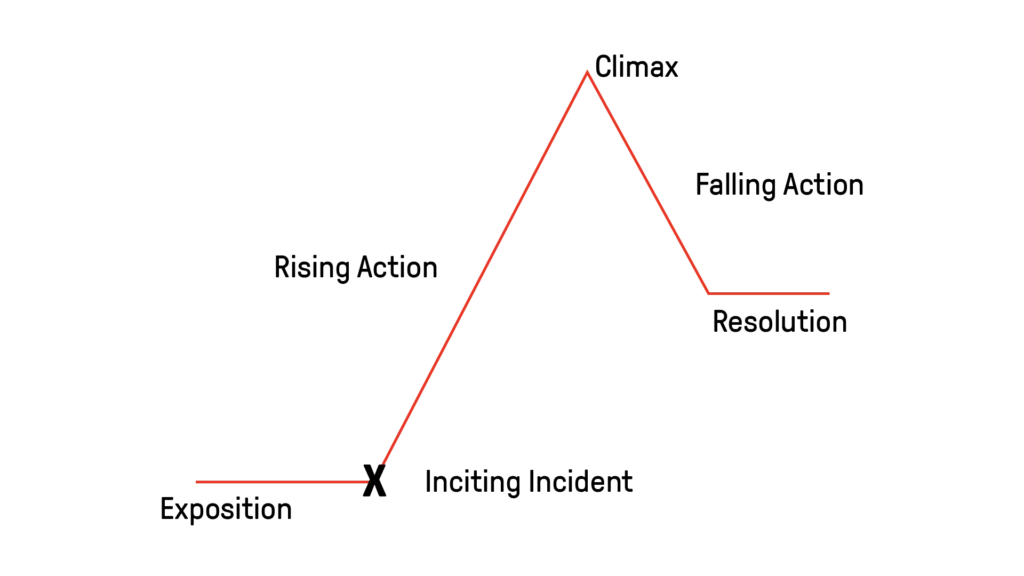
Freytag’s Pyramid is one of the oldest and simplest ways to structure a story. Developed from the work of 19th-century writer Gustav Freytag, it organizes a narrative around five core movements: exposition, rising action, climax, falling action, and resolution. For business leaders, this framework is useful because it shows how tension builds, how a decisive turning point changes the situation, and how the story lands in a clear outcome.
In a business context, Freytag is especially useful for case studies, transformation stories, keynote speeches, investor updates, and change management narratives. It gives leaders a clean way to show where things started, what pressure increased, what decision changed the trajectory, and what became possible afterward.
How The Freytag’s Pyramid Framework works
1. Exposition: Sets the stage. Introduce the company, customer, market, or team. Explain the normal operating reality before the major conflict appeared. This gives the audience the context they need to understand why the story matters.
2. Rising Action: Shows the pressure building. Describe the obstacles, market shifts, internal friction, customer pain, or competitive threats that make the old path harder to sustain. This section creates urgency and keeps the audience engaged.
3. Climax: Identifies the turning point. This is the moment when the leader, customer, or company makes a critical decision. In business storytelling, this could be a strategic pivot, a product launch, a new operating model, or a bold investment.
4. Falling Action: Shows what changed because of the decision. Explain the implementation, the consequences, the early proof points, and the adjustments that followed. This helps the audience see that the turning point created real movement.
5. Resolution: Ends with the new reality. Describe the measurable results, the lessons learned, and the stronger position created by the journey. This is where the story connects back to business value and leaves the audience with a clear takeaway.
Why It Works
- Simple and easy to understand.
- Very useful for case studies, transformation stories, and leadership communication.
- Builds pressure towards the decisive moment of your story.
Where It Falls Short
- Requires a clear turning point, which some business stories may lack.
- Does not emphasize a story of change.
- Does not apply for a product that is not fully developed.
Who is the Freytag’s Pyramid Framework right for?
Freytag’s Pyramid can be used in conjunction with almost any other framework to tell punchy, clear stories that build tension and hold attention.
9. The Pixar Story
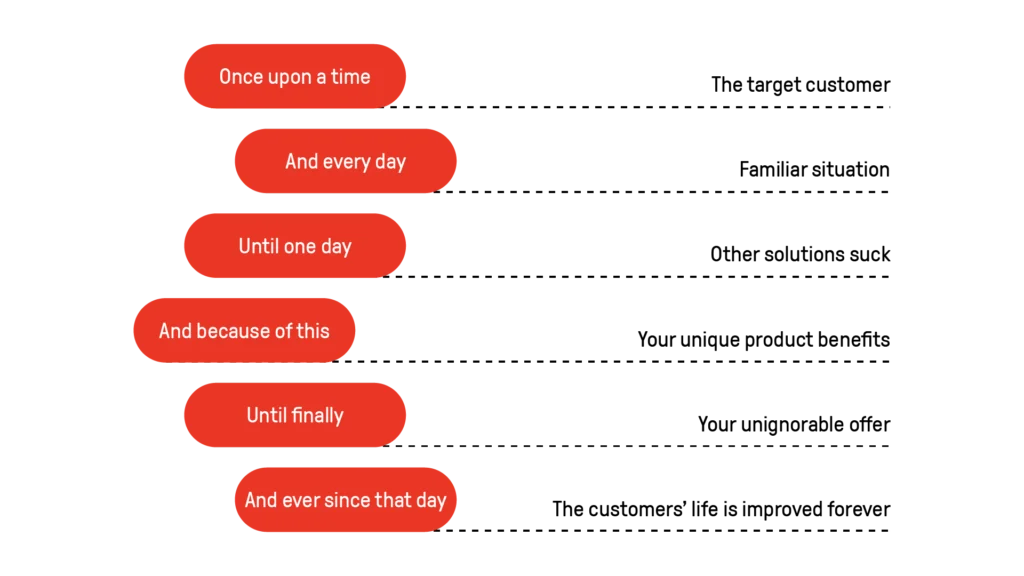
The Pixar Story framework, often called the Story Spine, is a simple sentence-based structure for building a clear and emotionally satisfying narrative. It is widely associated with Pixar’s (Toy Story, Finding Nemo) storytelling approach and is taught as a way to organize key story beats. The Story Spine itself was originally created by Kenn Adams and follows a pattern that moves from normal life, to disruption, to consequences, to resolution.
For business leaders, this framework is useful because it strips a story down to its essential logic. It helps teams explain change without overcomplicating the message. It is especially helpful for brand stories, product narratives, customer journeys, founder stories, and internal alignment messages.
How The Pixar Story Framework works
1. Once Upon a Time: Establishes the world by describing the customer, company, team, or market before the shift. This gives the audience a clear starting point and helps them understand who the story is about.
2. Every Day: Describes the routine to show what was happening repeatedly before the change. In business storytelling, this could be a common customer struggle, a recurring inefficiency, or an accepted industry practice.
3. One Day: Introduces the event or realization that changes everything. It could be a new market reality, a customer insight, a competitive threat, or an internal decision that forces action.
4. Because of That: Shows the first consequence to explain what the hero had to do once the disruption appeared. This begins the chain of cause and effect that gives the story momentum.
6. Until Finally: Delivers the breakthrough. This is the moment when the central problem is solved, the new strategy works, or the customer reaches a better state. It should feel earned because the audience has followed the sequence of events.
7. Ever Since That Day: Shows the new normal to explain what is different now. For a business audience, this should connect to stronger performance, clearer positioning, customer success, or a more compelling future.
Why It Works
- Creates a strong cause-and-effect flow that makes business stories easy to follow.
- Works well for pitches, customer stories, product launches, and leadership narratives.
- Ideal for trying out multiple narratives at once.
Where It Falls Short
- Does not apply to highly technical or multi-layered business stories.
- Lacks data or operational depth.
- Feels formulaic because it follows consistent sentence patterns.
Who is the Pixar Story Framework right for?
Founder-led brands who seek to connect their experience to the customer’s own story will find the Pixar Story magical.
Narrative as a Competitive Advantage
Focus on your company story and choose the most appropriate framework for your audience.
Can’t get enough of B2B brand storytelling? Download Story is the Strategy to discover more narrative frameworks and tools you can use.