
FletchPMM’s homepage-positioning methodology is one of the most respected approaches to fixing a broken B2B SaaS website. Founded by Anthony Pierri and Robert Kaminski in 2021, Fletch’s two-week sprint has helped more than 400 venture-backed startups turn confusing homepages into clear, focused ones built around a single positioning strategy.
But FletchPMM’s model is built for founders who need a homepage that generates leads, without the need for a full sales motion, an aligned team, or a go-to-market strategy built to scale beyond the page. This has real limitations for B2B leaders who need a story that travels beyond the homepage into sales conversations, marketing campaigns, customer success touchpoints, and company culture.
This guide covers the most credible alternatives to creating a homepage that converts buyers.
Who Do B2B Leaders Look for a StoryBrand Alternative?
| Framework | Best For |
| Woden’s StoryKernel | B2B companies with complex products, multi-stakeholder sales, and teams that need homepage copy backed by one aligned narrative that carries into every other channel and conversation |
| Andy Raskin’s Strategic Narrative | B2B tech companies that need to nail their positioning before a single word of homepage copy gets written |
| PitchMaps | Consulting firms and venture-backed CEOs whose positioning problem is fundamentally a narrative problem, and who need high-level strategic narrative for leadership alignment rather than updated homepage copy |
| StoryBrand | Founder-led B2B companies that need a rebuilt homepage plus the narrative and execution assets around it, delivered in a fixed-price sprint |
FletchPMM’s methodology operates on the belief that the homepage is a B2B SaaS company’s single most important, and most commonly ineffective, sales asset. Anthony Pierri and Robert Kaminski built FletchPMM in 2021 around a two-week, four-call sprint that produces four to six positioning strategies ranked by risk, a six-slide internal positioning deck, and a homepage wireframe with production-ready copy, priced by company stage: $10,000 for early-stage companies under $2MM in revenue, $20,000 for growth-stage companies, and $30,000 for mature companies over $20MM.
Why Trust Us
Woden’s StoryKernel engagement produces the strategic narrative that is the foundation a homepage needs to be built from, along with the sales deck, the onboarding sequence, and everything else a company goes to the market with. Woden has been doing this work since 2012, nine years before FletchPMM launched, and has run more than 300 StoryKernel engagements over 14 years, each one eventually developing into strategic messaging that lives on a client’s website.
The StoryKernel, Woden’s proprietary nine-part strategic narrative framework, is built to solve that deeper problem than website copy alone. This perspective on Fletch’s methodology comes from working daily with clients who have gone through it.
What is FletchPMM’s Homepage Methodology?
FletchPMM is a product marketing consultancy founded by Anthony Pierri and Robert Kaminski, who identified a recurring problem among early-stage SaaS startups. They discovered a systematic failure at the homepage level due to a lack of clarity around positioning. Anthony has since built a following of nearly 80,000 LinkedIn followers and been ranked the top product marketing voice worldwide by Favikon, almost entirely through free content rather than paid advertising.
Fletch’s sprint runs over two weeks and four live calls, and produces:
- Four to six positioning strategies, ranked by risk, based on an analysis of the client’s website, demo, sales calls, competitors, and an intake questionnaire
- An internal positioning strategy deck, six slides documenting the exact language for what the product is, who it’s for, the problem it solves, and the value it delivers
- A homepage wireframe with production-ready copy, mapped to the chosen positioning strategy
By design, FletchPMM doesn’t conduct customer interviews. The team relies on the client to already be the subject matter expert on their own buyers, which keeps the sprint fast and affordable but places the burden of validating the story on the client.
For early-stage B2B SaaS companies whose homepage doesn’t say anything a visitor can understand in the first five seconds, Fletch’s sprint is fast, focused, and built to improve that one page.
Why Should You Consider an Alternative to FletchPMM?
Fletch’s methodology is excellent at fixing a single, specific webpage. But B2B leaders who complete a FletchPMM sprint consistently run into three gaps:
- It focuses on the homepage and doesn’t expand the story to other channels. The sprint’s deliverables are a homepage wireframe and an internal deck. It doesn’t touch the sales deck, the onboarding sequence, the customer success handoff, or the pitch a rep gives on a discovery call. Without that additional structure, a company can end up with a sharp homepage and a scattered story everywhere the buyer engages next.
- It skips the research that positioning needs to hold up. FletchPMM deliberately doesn’t interview customers, and leans on the client’s own read of their buyers. That works well for a single, well-understood segment, but it leaves a gap for companies selling into multiple stakeholder groups whose language hasn’t been tested against real buyer interviews.
- It’s priced and scoped for a single sprint. Once the two weeks and four calls are done, the deliverable is frozen. There’s no built-in infrastructure to keep the story consistent as the buyer, the competitive landscape, or the product itself changes in the years that follow.
5 FletchPMM Positioning Alternatives Worth Considering in 2026
There’s no single alternative that fits every company’s situation. Not every company in need of positioning is a B2B SaaS. Some need positioning clarity before they ever touch their homepage. Others need a high-stakes narrative for a leadership or investor pitch. Some need a homepage plus a fuller set of execution assets, or a free, self-serve template to start with. And some need the full narrative, plus the organizational infrastructure to sustain it for years. The five alternatives below each solve a different version of that gap.
| Framework | Best For | Core Strength | Why Choose It | Rating | Pricing |
| Woden’s StoryKernel | B2B companies with complex products, multi-stakeholder sales, and teams that need one aligned narrative across every channel and conversation | Nine-part strategic narrative built through six weeks of deep research that aligns every team member and produces a full Messaging Hierarchy | The only framework that includes deep customer and competitive research, organizational coaching, and AI powered by the narrative itself | 4.9 Clutch | From $13,500 |
| April Dunford’s Five Component Positioning Framework | B2B tech companies that need to nail their positioning before building a homepage or any other asset | Five-component positioning framework that identifies the best possible context for a product in the market | Produces the positioning clarity that makes every other framework work better | Not listed | $275 book / $80,000-100,000 Workshop |
| Andy Raskin’s Strategic Narrative | Venture-backed CEOs who need leadership-level alignment around a high-level narrative and have the internal team to execute | Five-step framework anchored in naming a big market shift that makes the buyer’s status quo untenable | Produces a story arc built to open a high-stakes pitch, rather than a document that defines where the product sits in the market | Not listed | $100,000+ per engagement |
| PitchKitchen | Founder-led B2B companies between $5M and $75M ARR that need narrative plus execution in one fixed-price engagement | 90-day sprint that delivers a Magnetic Messaging Framework, rebuilt homepage, sales deck, AI Brand Twin, and trained sales team | Delivers a homepage as one asset among several, alongside a sales deck, AI Brand Twin, and trained sales team, so the story doesn’t stop at the page | Not listed | $25,000-$45,000 per sprint |
Woden’s StoryKernel
Best for: B2B leaders with complex products, multi-stakeholder sales, and teams that need one precise story across every conversation.
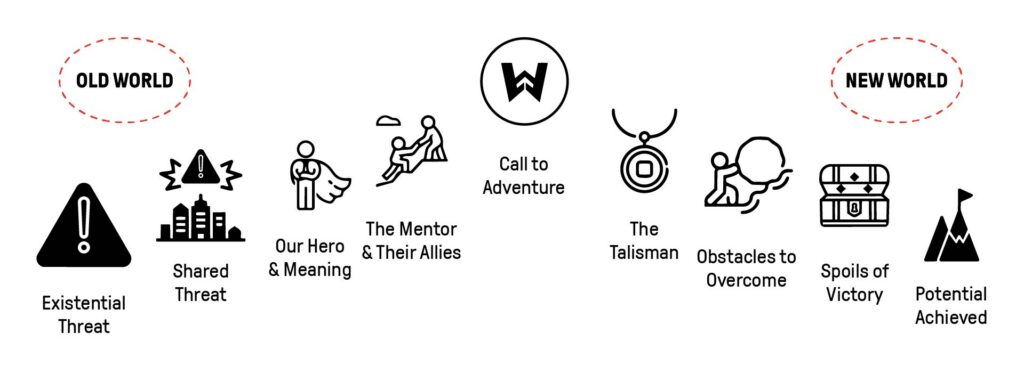
Woden built the StoryKernel as a proprietary strategic narrative framework for B2B companies that need one consistent story across every team, sales conversation, and stage of the customer journey. Six weeks of research into a company’s customers, employees, competitors, and market feed into the process, resulting in a nine-part, customer-centric narrative that anchors everything the brand takes to market.
“Woden helped us uncover, define, and reframe our company narrative through a detailed process…We’re impressed with their creative insight and willingness to immerse themselves in our business.”
— Kevin Ledversis | Vice President of Sales, Newcastle Systems | Read the full case study
How It Tells Your Story
- Helps develop website copy around an unavoidable shift in the market that displays the cost of inaction
- Positions the customer as the hero navigating that shift and the brand as the credible mentor
- Builds a nine-part narrative arc that understands what stage of the buying journey your customer is at when they land on the homepage
- Produces a Messaging Hierarchy that gives every team member the tools and language to describe the brand’s value
- Drives a clear go-to-market motion that anchors every sales conversation, marketing asset, and leadership communication in the same core narrative.
Key Features
- Nine-part strategic narrative framework built through six weeks of deep research
- Interviews with customers, employees, competitors, partners, and investors
- Complete Messaging Hierarchy derived from the narrative
- Proprietary Transformation Journey change management framework that moves the organization from knowing the story to living it
- Designed for five or more years of narrative consistency
- Backed by Woden’s guarantee: if we do not uncover what makes your brand essential, we will refund the full fee paid
- Powered by StoryEngine, Woden’s AI platform that eliminates Narrative Drift and puts the story at every employee’s fingertips
What It Has That FletchPMM Doesn’t
A homepage is only one piece of the puzzle, and it’s the piece that’s hardest to get right when it’s built before the underlying story exists. That’s FletchPMM’s biggest flaw, it jumps right into the homepage without establishing the narrative. The StoryKernel starts with a nine-part narrative arc that builds urgency, sharpens differentiation, and can travel seamlessly across the buying journey.
By establishing a narrative through-line, there’s already a story and defined viewpoint to build the homepage from. That same arc becomes a Messaging Hierarchy that sales, customer success, and leadership all use, which means the homepage ends up saying the same thing that the sales deck says, a rep says on a discovery call, and a customer success team member repeats during onboarding. FletchPMM’s two-week sprint is only a band-aid solution to a much larger issue.
Once that homepage goes live, the engagement ends, and nothing carries the story forward as the product, market, or team changes.If the entire goal is a sharper homepage that converts more visitors into leads, FletchPMM delivers exactly that. But if the story needs to travel beyond the page into every sales conversation, every piece of content, and every person on the team, a homepage sprint was never going to be enough to get it there.
See what Woden clients are saying on Clutch. | Connect with Woden on LinkedIn.
April Dunford’s Five Component Positioning Framework
Best for: B2B tech companies that need to nail their positioning before building the messaging around it.
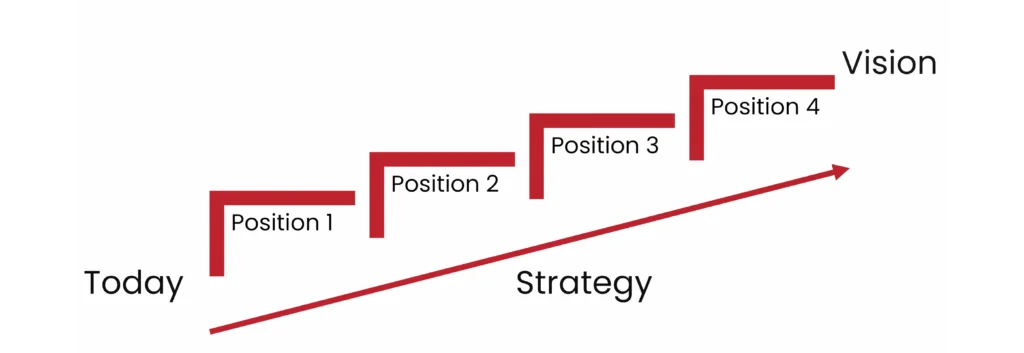
April Dunford spent 25 years as a repeat VP of Marketing at a string of venture-backed startups before moving into consulting in 2015. She’s the author of Obviously Awesome, now considered the definitive book on B2B product positioning, and has since worked with more than 200 companies, from early-stage startups to Google and Epic Games. Her work goes beyond the homepage itself by helping companies figure out what to say before copy gets developed.
“As CEO one of the most important jobs is to help articulate your company’s point of view into a compelling story. We went on this journey with April and it transformed our business.”
— CEO, B2B Tech Company
How It Builds Your Narrative and Puts It to Work
- Identifies the competitive alternatives buyers are actually comparing the product against
- Uncovers the unique attributes the product has that those alternatives lack
- Defines the value those attributes create for a specific set of buyers
- Determines the target customer characteristics that make the product an easy yes
- Places the product in the market category that makes its value obvious
Key Features
- Five-component positioning framework: competitive alternatives, unique attributes, value, target customer characteristics, and market category
- Built for B2B tech companies with complex products in crowded markets
- Designed to be completed collaboratively with the full leadership team
- Intensive workshop format, typically spanning several days
- Consulting engagements priced between $80,000 and $100,000 for larger organizations
Where It Falls Short
Dunford’s methodology produces sharp positioning clarity, but the engagement stops there. It doesn’t extend into the homepage copy, the sales deck, or the broader narrative arc a buyer moves through during a long, multi-stakeholder decision. It’s most valuable as the strategic groundwork underneath a narrative or messaging engagement.
Learn more about April Dunford.
Andy Raskin’s Strategic Narrative
Best for: Venture-backed CEOs at growth-stage companies who need leadership-level alignment around a high-level narrative and have the internal infrastructure to translate that strategy into execution.
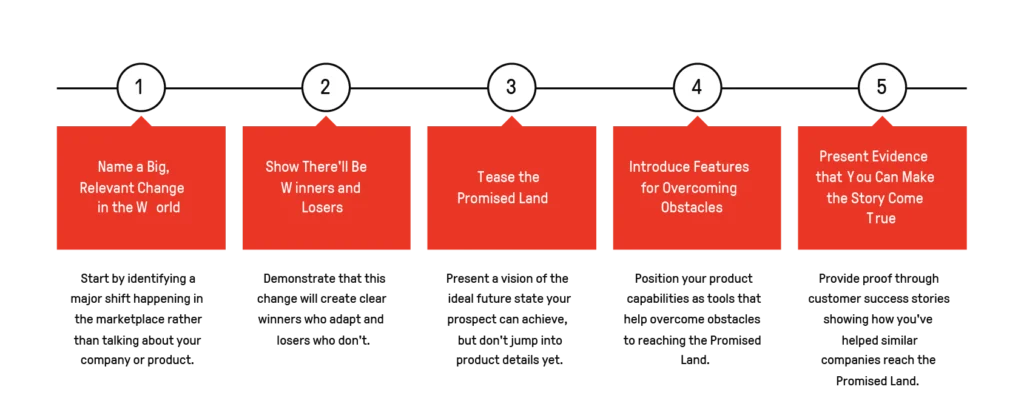
Andy Raskin has consulted on strategic narrative for clients including Salesforce, Gong, Dropbox, Uber, and Intercom. He built his reputation on a viral breakdown of Zuora’s pitch deck, which laid out his central argument that the strongest pitches open with a shift happening in the world rather than the product itself. His five-step approach has since become a standard reference for B2B sales narrative at the leadership level, but it was built for the boardroom and the pitch deck.
“As our product offering expanded, we needed a story to help people—inside and outside the company—boil down why we matter. Andy got us aligned on one that’s already driving future growth, which is no small feat given the strong personalities in my team!”
— Alex MacCaw, CEO, Clearbit
How It Improves Your Positioning
- Opens by naming a big, relevant, and undeniable shift in the buyer’s world
- Shows winners and losers to create urgency through loss aversion and desirability
- Teases a promised land that is improbable without the brand’s guidance
- Introduces features as magic gifts that help the hero overcome obstacles to the promised land
- Closes with evidence last, after the story has already been believed
Key Features
- Five-step framework optimized for leadership alignment and high-stakes pitch narratives
- Built around the concept that CEOs must inspire both their own team and the organizations they sell to
- Deep expertise in venture-backed and enterprise-scale go-to-market narratives
- Highly selective engagement model working directly with CEOs and senior leadership
- Engagements start at $100,000 and above
Where It Falls Short
Raskin’s model works best for a CEO who already understands the market shift and just needs a story built to open the highest-stakes conversations in the room. It has nothing to offer a team wrestling with confusing website copy, unclear sales collateral, or messaging that hasn’t been tested against how buyers actually talk. There’s no research process built in to check whether the language lands, and no attention paid to the sentence-level work a homepage or sales deck actually needs. If the real problem is a jargon-heavy website rather than a boardroom narrative, Raskin’s framework isn’t the solution.
Learn more about Andy Raskin’s Strategic Narrative.
PitchKitchen
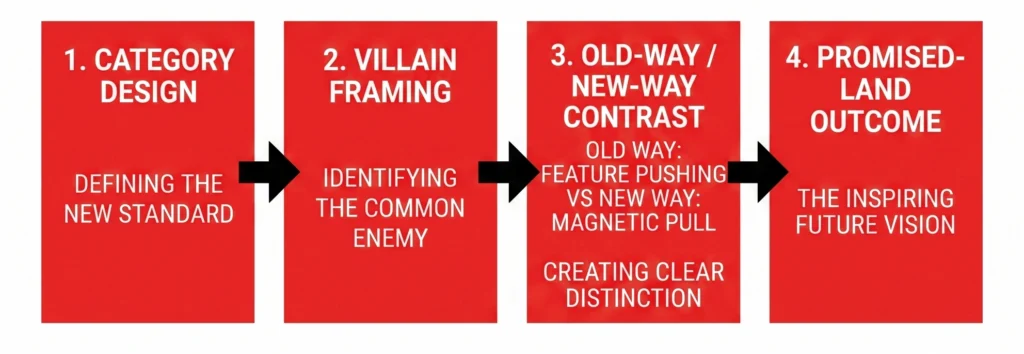
Best for: Founder-led B2B companies between $5M and $75M ARR whose sales are stalling because the message is not doing the work, and who need narrative plus execution delivered in a single fixed-price engagement.
Founded by Greg Rosner, author of StoryCraft for Disruptors, PitchKitchen builds Magnetic Messaging Frameworks for founder-led B2B companies. Its 90-Day Magnetic Messaging Sprint pushes narrative thinking beyond a single deliverable, embedding it straight into the assets a sales team actually uses day to day. That includes a rebuilt homepage, a redesigned sales deck, and an AI Brand Twin deployed across OpenAI, Gemini, and Claude.
“When I started ScaleSpark, we sounded like every other ops consultancy. ‘Back-office support.’ ‘Finance, HR, IT.’ Words that disappeared the second a founder heard them. I worked with Greg on positioning. He didn’t tighten our copy. He named a new category.”
– Maria Pienaar, CEO, ScaleSpark.ai
How It Improves Your Positioning
- Builds a Magnetic Messaging Framework that resets the brand’s position and the transformation it sells
- Delivers a story-driven homepage as a finished, published website
- Produces a Discovery Prompter sales deck that guides the buyer through the narrative
- Trains an AI Brand Twin deployed across OpenAI, Gemini, and Claude with the brand’s specific story
- Includes sales training so the team can deliver the new narrative in customer conversations
Key Features
- 90-day fixed-price sprint: $25,000 to $45,000 depending on scope
- All deliverables included: framework, homepage, sales deck, AI Brand Twin, email sequences, and sales training
- AI-native execution with a dedicated agent trained on the client’s specific Magnetic Messaging Framework
- Monthly Open Kitchen subscription available at $4,995 per month for ongoing execution
- Clients include Teradata, Calabrio, Glytec, and Trilio
Where It Falls Short
PitchKitchen is built primarily for B2B SaaS and tech companies in the $5M to $75M range. Its 90-day sprint model favors speed and execution over the deep organizational research that a complex, multi-stakeholder company needs to align an entire workforce behind one story. For companies whose challenge began with a single-page fix and now needs to hold up for five or more years of narrative consistency, the sprint format may fall short.
Learn more about PitchKitchen.
Choosing the Right Framework
FletchPMM’s methodology is the right choice for early-stage founder-led SaaS companies that need a focused, well-positioned homepage fast, and don’t yet need the story to extend beyond that page. For every other situation, the right alternative depends on what the organization actually needs:
- Need positioning clarity with a core leadership team > April Dunford’s Obviously Awesome
- Need a strategic narrative driven by the CEO > Andy Raskin
- Clear homepage messaging that converts visitors > FletchPMM
- Strong bias towards marketing execution > PitchKitchen
- Need a self-serve framework for a simple product> StoryBrand SB7
- Need a strategic narrative that aligns each member of the team and go-to-market > Woden’s StoryKernel
If you are a strategic B2B leader whose product requires the market to think differently about an existing problem, whose team is not telling a consistent story, or whose brand is losing deals to competitors with a lower price and a similar pitch, the StoryKernel is built exactly for you.
More than 300 B2B brands have used their StoryKernel to win more best-fit buyers for less. Want buyers to understand what makes you different?
Get Started: We Will Record an Analysis of Your Current Story