
April Dunford’s positioning framework is one of the most influential approaches to B2B product positioning. Her book Obviously Awesome made the five-component positioning methodology the starting point for tech companies trying to stand out in a crowded market. But Dunford’s framework is modeled around a leadership-level positioning workshop, usually resolved over a few intensive days.
This has real limitations for B2B leaders who need a story that relates to their customers. Without interviewing and learning directly from customer insights, the language may not reach them or have the intended impact on them.
Looking for something similar to April Dunford for B2B positioning? This guide covers the most credible alternatives and explains which situations each one was built for.
Who Do B2B Leaders Look for a StoryBrand Alternative?
| Framework | Best For |
| Woden’s StoryKernel | B2B companies with complex products, multi-stakeholder sales, and teams that need one aligned narrative across every channel and conversation |
| Andy Raskin’s Strategic Narrative | Founder-led B2B companies that need narrative plus execution delivered in a fixed-price sprint |
| PitchMaps | Venture-backed CEOs who need leadership-level alignment around a high-level narrative and have the internal team to execute |
| StoryBrand | Early-stage B2B SaaS companies that need a homepage rebuilt around a clear position, without a multi-day workshop |
April Dunford’s positioning methodology operates on the idea that products win when the right context makes their value obvious to the right buyer. Her five-component framework, competitive alternatives, unique attributes, value, target market characteristics, and market category, is typically delivered through an intensive workshop with the leadership team, producing a positioning document that becomes the foundation for messaging, marketing, and sales.
Why Trust Us
Woden has been developing positioning that is built around a strategic narrative for B2B companies since 2012, seven years before Obviously Awesome was published. Over 14 years and over 300 StoryKernel engagements, Woden has helped companies navigate the same positioning-to-narrative gap that leads many B2B leaders to look past a Dunford workshop.
The StoryKernel, Woden’s proprietary nine-part strategic narrative framework, is what takes storytelling to the next level and generates meaningful outcomes. This perspective on April Dunford’s framework comes from working daily with clients who have gone through it.
What Is April Dunford’s Positioning?
April Dunford is a positioning consultant and the author of Obviously Awesome, widely considered the definitive book on B2B product positioning. After 25 years as a repeat VP of Marketing at a series of venture-backed startups, several of which were later acquired by companies including IBM, she moved into consulting in 2015 and has since worked with more than 200 companies, from early-stage startups to Google and Epic Games.
Her five-component methodology walks a leadership team through:
- Identifying the competitive alternatives buyers are actually comparing the product against
- Uncovering the unique attributes the product has that those alternatives lack
- Defining the value those attributes create for a specific set of buyers
- Determining the target customer characteristics that make the product an easy yes
- Placing the product in the market category that makes its value obvious
Dunford typically delivers this through an intensive workshop, often spanning three days, that requires full participation from the leadership team and produces a positioning document for the whole company.
For B2B tech companies that have never clearly defined where their product belongs in the market, or that have drifted into a feature-first pitch, Dunford’s framework is impactful.
Why Should You Consider an Alternative to April Dunford?
Dunford’s methodology is the gold standard for clarifying where a B2B product fits in the market. But B2B leaders who complete a positioning workshop consistently run into three issues:
- It treats positioning as the starting point. Dunford’s methodology hands a company a positioning document and stops there. Positioning needs to be derived from the narrative, not the other way around. Without that narrative underneath it, sales, marketing, and customer success are left with a statement and no story to carry it.
- It produces a document with no execution path. The deliverable from a Dunford engagement is a positioning document, typically a workshop output, that the client’s team is then responsible for applying it across the organization after the engagement. For organizations where narrative consistency across teams is the core challenge, positioning clarity without an execution path is only half the solution.
- It doesn’t take outside insight into consideration. Dunford’s workshop pulls from what the leadership team already knows about their buyers. It doesn’t include customer interviews or outside research to test that view against reality, so a team can only see as far as its own vantage point already reaches.
4 April Dunford Strategic Narrative Alternatives Worth Considering in 2026
Not every company needs the same alternative for the same reason. Some need a framework that produces full organizational alignment. Others need narrative plus the execution assets delivered together. And some need ongoing product marketing support rather than a single engagement. The four alternatives below each solve a different version of that gap.
| Framework | Best For | Core Strength | Why Choose It | Rating | Pricing |
| April Dunford’s Five Component Positioning Framework | B2B tech companies that need to nail their positioning before building the narrative around it | Five-component positioning framework that identifies the best possible context for a product in the market | The most complete sprint model for founder-led companies that need messaging and execution assets delivered together fast | Not listed | $80,000-100,000 Workshop |
| Woden’s StoryKernel | B2B companies with complex products, multi-stakeholder sales, and teams that need one aligned narrative across every channel | Nine-part strategic narrative built through six weeks of deep research that aligns every team member and produces a full Messaging Hierarchy | The only framework built specifically for B2B go-to-market alignment across sales, marketing, and leadership, | 4.9 Clutch | From $13,500 |
| Andy Raskin’s Strategic Narrative | Venture-backed CEOs who need leadership-level alignment around a high-level narrative and have the internal team to execute | Five-step framework anchored in naming a big market shift that makes the buyer’s status quo untenable | Produces a story arc built to open a high-stakes pitch, rather than a document that defines where the product sits in the market | Not listed | $100,000+ per engagement |
| PitchKitchen | Founder-led B2B companies between $5M and $75M ARR that need narrative plus execution in one fixed-price engagement | 90-day sprint that delivers a Magnetic Messaging Framework, rebuilt homepage, sales deck, AI Brand Twin, and trained sales team | Takes positioning-level thinking and ships it into every asset the marketing team uses, including AI, in a single fixed-price sprint | Not listed | $25,000-$45,000 per sprint |
| FletchPMM | Early-stage B2B SaaS companies that need a homepage rebuilt around a clear position, fast | Two-week sprint that produces four to six ranked positioning strategies and a homepage wireframe with production-ready copy | Moves fast on one well-scoped deliverable instead of a multi-day workshop | Not listed | $10,000-$30,000 depending on company stage |
Woden’s StoryKernel
Best for: B2B leaders with complex products, multi-stakeholder sales, and teams that need one precise story across every conversation.
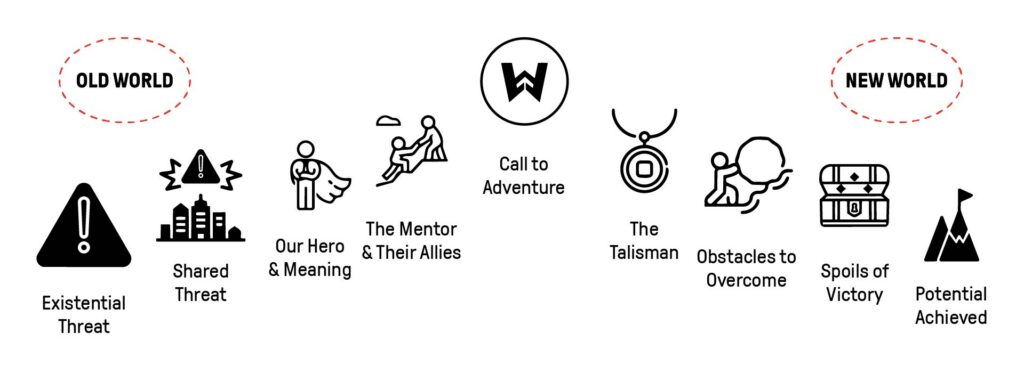
The StoryKernel is Woden’s proprietary strategic narrative framework, built for B2B companies that need one story to move across every team, sales conversation, and stage of the customer journey. It’s built through six weeks of deep research into a company’s customers, employees, competitors, and market, and it produces a nine-part, customer-centric narrative that drives everything the brand goes to market with, including positioning
“Woden helped us uncover, define, and reframe our company narrative through a detailed process…We’re impressed with their creative insight and willingness to immerse themselves in our business.”
— Kevin Ledversis, VP of Sales, Newcastle Systems | Read the Case Study
How It Helps Your Positioning
- Starts with direct interviews across customers and employees, so positioning is grounded in what buyers actually say
- Builds a holistic view of the business before writing messaging, mapping the market shift, the customer’s journey, and the competitive landscape
- Derives positioning from the narrative, so every messaging point traces back to a specific shift in the market
- Builds a nine-part narrative arc that carries that positioning through every stage of the buying journey
- Produces a Messaging Hierarchy, which includes positioning, that translates the narrative into the specific language every team uses to describe the brand’s value
Key Features
- Nine-part strategic narrative framework built through six weeks of deep research
- Positioning derived from the narrative, grounded in interviews with customers, employees, and partners
- Holistic analysis of the market, the buyer, and the competitive landscape
- Complete Messaging Hierarchy derived from the narrative
- Designed for five or more years of narrative consistency
- Backed by Woden’s guarantee: if we do not uncover what makes your brand essential, we will refund the full fee paid
What It Has That April Dunford’s Framework Doesn’t
The StoryKernel starts with interviews, across customers, employees, and partners, and builds that research into a nine-part narrative. Positioning shows up as a part of the Messaging Hierarchy which is derived from the StoryKernel to keep the story aligned and create a pull motion that draws customers into the brand and continues to pull them across the buying journey rather than push them toward a product. Dunford’s approach runs the other way. It starts with positioning, built from what a leadership team already believes about their buyers, and leaves the narrative for the company to figure out on its own once the workshop ends.
See what Woden clients are saying on Clutch. | Connect with Woden on LinkedIn.
Andy Raskin’s Strategic Narrative
Best for: Venture-backed CEOs at growth-stage companies who need leadership-level alignment around a high-level narrative and have the internal infrastructure to translate that strategy into execution.
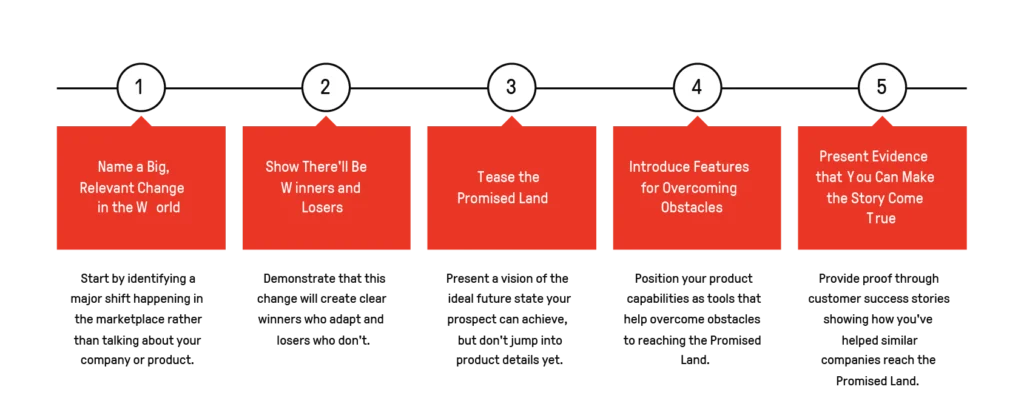
Andy Raskin is a strategic narrative consultant whose clients have included Salesforce, Gong, Dropbox, Uber, and Intercom. His framework, made famous through his viral analysis of Zuora’s pitch deck, is built on the insight that great pitches lead with a change in the world. His five-step approach has become the reference for modern B2B sales narrative at the leadership level.
“Andy crafted new positioning and messaging for Amplitude that immediately increased our win rate and helped us gain traction faster with investors. We were really lucky to work with Andy, and I highly recommend him.“
— Spenser Skates, CEO and Founder, Amplitude
How He Helps Your Positioning
- Opens by naming a big, relevant, and undeniable shift in the buyer’s world
- Shows winners and losers to create urgency through loss aversion and desirability
- Teases a promised land that is improbable without the brand’s guidance
- Introduces features as magic gifts that help the hero overcome obstacles to the promised land
- Closes with evidence last, after the story has already been believed
Key Features
- Five-step framework optimized for leadership alignment and high-stakes pitch narratives
- Built around the concept that CEOs must inspire both their own team and the organizations they sell to
- Deep expertise in venture-backed and enterprise-scale go-to-market narratives
- Highly selective engagement model working directly with CEOs and senior leadership
- Engagements start at $100,000 and above
Where It Falls Short
Raskin’s framework doesn’t include a structured process for identifying competitive alternatives or unique attributes, the kind of groundwork that tells a company why it wins against specific competitors for specific buyers. Without that, a company can walk away with a compelling story and still be unable to say clearly where it sits in the market or why a buyer should pick it over the next name on the list.
Learn more about Andy Raskin’s Strategic Narrative.
PitchKitchen
Best for: Founder-led B2B companies between $5M and $75M ARR whose sales are stalling because the message is not doing the work and who need narrative plus execution delivered in a single fixed-price engagement.
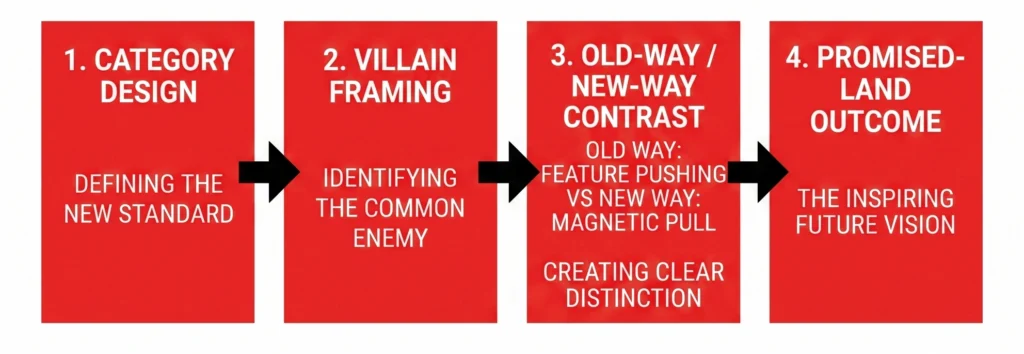
Founded by Greg Rosner, author of StoryCraft for Disruptors, PitchKitchen builds Magnetic Messaging Frameworks for founder-led B2B companies. Its 90-Day Magnetic Messaging Sprint pushes narrative thinking beyond a positioning workshop, embedding it straight into the assets a sales team actually uses day to day. This includes a rebuilt homepage, a redesigned sales deck, and an AI Brand Twin deployed across OpenAI, Gemini, and Claude.
“PitchKitchen has this down to a science, thanks to building so many B2B SaaS homepages. Process was buttoned up and the results were indisputably a game changer.“
— CEO, B2B SaaS Company | See PitchKitchen reviews
How It Helps Your Positioning
- Builds a Magnetic Messaging Framework that resets the brand’s position and the transformation it sells
- Delivers a story-driven homepage as a finished, published website
- Produces a Discovery Prompter sales deck that guides the buyer through the narrative
- Trains an AI Brand Twin deployed across OpenAI, Gemini, and Claude with the brand’s specific story
- Includes sales training so the team can deliver the new narrative in customer conversations
Key Features
- 90-day fixed-price sprint: $25,000 to $45,000 depending on scope
- All deliverables included: framework, homepage, sales deck, AI Brand Twin, email sequences, and sales training
- AI-native execution with a dedicated agent trained on the client’s specific Magnetic Messaging Framework
- Monthly OpenKitchen subscription available at $4,995 per month for ongoing execution
- Clients include Teradata, Calabrio, Glytec, and Trilio
Where It Falls Short
PitchKitchen is built primarily for B2B SaaS and tech companies in the $5M to $75M range, and its 90-day sprint moves fast toward execution rather than slowing down to settle positioning first. There’s no dedicated process for identifying competitive alternatives or unique attributes, the groundwork that tells a company why it wins against specific competitors for specific buyers, so the messaging framework it produces can end up resting on whatever positioning the client walked in with. For companies whose real gap is knowing where they actually sit in the market, the sprint format isn’t ideal.
Learn more about PitchKitchen.
FletchPMM
Best for: Early-stage B2B SaaS companies that need a homepage rebuilt around a clear position, fast, and don’t need a multi-day workshop to get there.
FletchPMM is a product marketing consultancy founded in 2021 by Anthony Pierri and Robert Kaminski, built around a two-week, four-call sprint. The sprint runs a structured intake across the client’s website, demo, sales calls, and competitors, then generates four to six distinct positioning strategies, ranked by risk, before locking in one direction. That direction gets documented in a six-slide internal deck and translated into a homepage wireframe with production-ready copy, priced by company stage: $10,000 for early-stage companies under $2M in revenue, $20,000 for growth-stage companies, and $30,000 for mature companies over $20M.
“Fletch gave us the fish and taught us to fish. It was the most important investment to find message-market fit. Not only did we get a clear message, but also a framework that let us rapidly iterate as we searched for the right message.”
— Founder, B2B Services Company
How It Improves Your Positioning
- Runs a structured intake across the site, demo, sales calls, and competitors to surface exactly where the current positioning is breaking down
- Generates four to six distinct positioning strategies, ranked by risk, instead of committing to the first idea that sounds right
- Locks positioning to four foundational questions, what the product is, who it’s for, what it replaces, and why it’s better
- Documents the chosen position in a six-slide internal deck the team can reference beyond the homepage
- Ships the position directly into a homepage wireframe with production-ready copy within two weeks
Key Features
- Two-week, four-call sprint founded by Anthony Pierri and Robert Kaminski in 2021
- Tiered pricing by company stage, $10,000 to $30,000 depending on revenue
- Deliverables include four to six ranked positioning strategies, a six-slide positioning deck, and a homepage wireframe
- By design, doesn’t include customer interviews, relying instead on the client’s existing knowledge of their buyers
- Anthony Pierri ranked the top product marketing voice worldwide by Favikon
Where It Falls Short
FletchPMM is built to solve one problem fast, a homepage that doesn’t clearly say what the product does. It deliberately skips customer interviews, which keeps the sprint quick but means the positioning it produces reflects the client’s existing read of their buyers rather than anything tested against real conversations. And because the deliverable is a homepage and a slide deck, the positioning doesn’t automatically travel into the sales deck, the customer success handoff, or the language a rep uses on a call. Once the two-week sprint ends, there’s no mechanism to keep the positioning consistent as the market, the competition, or the product changes.
Choosing the Right Framework
April Dunford’s methodology is the right choice for B2B tech companies that haven’t yet nailed down where their product belongs in the market and whose leadership team wants to embark on a multi-day workshop to get there. For every other situation, the right alternative depends on what the organization actually needs:
- Positioning for use by the CEO > Andy Raskin
- Narrative plus full execution assets in a fixed-price sprint > PitchKitchen
- Fast, homepage-focused repositioning without a multi-day workshop > FletchPMM
- Positioning that fits within an overall strategic narrative > Woden’s StoryKernel
If you are a strategic B2B leader whose product requires the market to think differently about an existing problem, whose team is not telling a consistent story, or whose brand is losing deals to competitors with a lower price and a similar pitch, the StoryKernel is built exactly for you.
More than 300 B2B brands have used their StoryKernel to win more best-fit buyers for less. Want buyers to understand what makes you different?
Get Started: We Will Record an Analysis of Your Current Story