
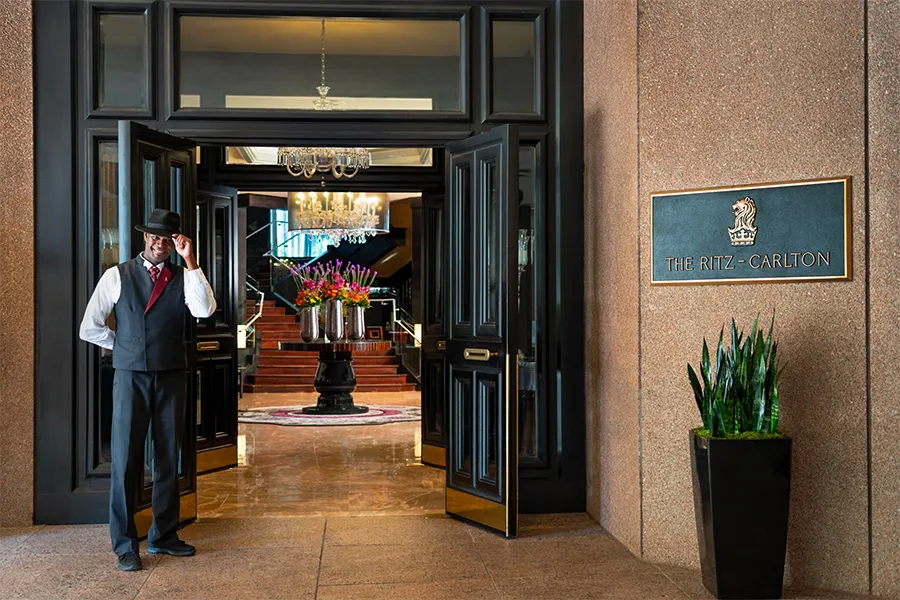
How Ritz-Carlton Designed Its Culture to Deliver
On the surface, most luxury hotels look the same. From the impeccably-designed lobby to knowledgeable concierge and the flavored water station, and from the carefully curated ambient music to the signature “hotel” scent, the surface-level view is often interchangeable.
That shouldn’t be surprising for travelers. The continued consolidation in the hotel industry has resulted in just ten largest brands controlling over 65 percent of U.S. room supply. The product—a room with a bed–is identical, and even when the sign on the building is different, the ownership is often the same. True differentiation has become that much harder to find.
The question of what actually sets luxury hotels apart isn’t unique to them. Consolidation has accelerated across all industries. When customers view one product as interchangeable with another, it is the story that sets similar options apart. In service brands, that story comes alive in the brand’ culture.
Culture is a critical question in all service industries, but especially in lodging which is projected to grow at a compound annual growth rate of 7.2 percent until 2030. And as the market expands but the number of players shrink, experience that goes beyond standard amenities is the intersection where these trends meet.
Excellence Beyond Standard Amenities
According to McKinsey, the answer does not lie in the design of the lobby or the thread count of the sheets, but in something deeper:
“The most powerful differentiator in the service sector is a culture of excellence—powered by staff that can anticipate customers’ needs, exceed expectations, create cherished memories, and make it all feel seamless.”
Matthew Upchurch, CEO of luxury travel agency network Virtuoso, agrees, stressing that success in luxury hospitality hinges on investing in staff and culture:
“Hospitality players that really focus on their employees, their culture, their service levels—those properties where you can truly feel the presence of the general manager—are the ones that will excel.”
Consumer data backs this up. In a 2025 survey by Flywire Corp, nearly 80 percent of affluent U.S. travelers were willing to pay more for personalized experiences that leave them feeling recharged and enriched.
But “great service” is ubiquitous and expected at brands like Four Seasons, Ritz-Carlton, W, and St. Regis. What differentiates these brands isn’t that the service is great; it is the unique way in which this service is delivered.
This is true for any service-based brand. Great service is expected, so what differentiates you is the unique way that service is delivered. The brands that generate the most loyalty and strongest growth define how they serve customers in their strategic narrative. They use this narrative to set expectations with potential customers, and then define the culture so the brand is positioned to deliver on that promise.
In hospitality, the culture is defined by the interactions between a guest and the employees. In other words: a company’s culture is defined by its story, but its value is only equal to the customer’s experience with the brand.
This is where most brands fall short.
Why Generic Service Cultures Fail
Culture and service expectations are equally undifferentiated in most organizations. In brands lacking a strategic narrative, culture is rarely anchored in a defined purpose. This can still result in good people working together to serve customers as well. But generically good service isn’t enough in competitive markets, and base expectations fail to give their employees the tools and autonomy to actually deliver on the customer’s true needs.
The gold standard in this regard is The Ritz-Carlton.
Since its first hotel opened in 1911, the Ritz-Carlton brand has been synonymous with a unique ability to consistently deliver extraordinary experiences across the globe. Talk to any current or former Ritz-Carlton employee, and it is immediately clear that this consistency is not accidental. It’s the result of a deeply intentional culture built on a clear and universally understood narrative, repeatable systems that reinforce it, and empowerment to embrace it fully.
As Horst Schulze, cofounder and former COO of The Ritz-Carlton Hotel Company, explains, it all starts with a commitment to creating excellence.
This idea was given to him as a 14-year-old busboy in a small European hotel, where a maître d’ gave him advice that would shape his entire philosophy: “Don’t come to work to work. Come here to create excellence.”
Shulze admits that the message went over his head at the time, but he came to see that excellence wasn’t about being perfect; it was about creating a shared purpose for employees and aligning their actions around it.
He describes giving purpose as an obligation of an organization, and that this shared purpose must tie together employees and customers. As he explains, “I didn’t just want them to fulfill a function. I wanted them to join us in our dreams…I invited them to join a purpose, told them the motive of that purpose, and connected their motives to the motive of the organization.”
Codifying Purpose Into Shared Narrative
Founders and executives like Shulze intuitively understand the brand’s purpose. The invitation for others to join them and the motivations to achieve it require a story. Stories are how people understand abstract concepts like purpose, internalize them, and share them with others.
All stories exist to communicate a lesson to their audience—a moral. When a brand develops their strategic narrative, they use their purpose as the moral of the story. Because all of the organization’s storytelling is patterned off this “mother story,” it ensures this purpose is universally understood.
As a result, Ritz-Carlton’s purpose comes alive through an entire system of storytelling. The Ritz-Carlton strategic narrative comes to life through their Gold Standards, a foundational framework established from the beginning of the company’s existence. These standards include their credo, motto, twelve service values, and the employee promise.
Herb Humler, the President & Chief Operations Officer of The Ritz-Carlton Hotel Company, describes how he recognized the importance of storytelling across the Ritz culture early on:
“Inscribe your culture, your vision and your mission, and make it a part of everything you do. We remind people all the time what our philosophy is here. We remind them through rituals like lineup. If you don’t inscribe these things, they will go away.”
Ritz’s lineups occur three times a day in every hotel with its flag around the world. Lineups in many ways look like the standups found in many companies to set priorities, discuss ongoing issues, introduce new processes. But at the Ritz these principles come alive through the sharing of a ‘Wow’ story: a moment where an employee created a memory for someone that will last a lifetime.
Attracting Talent With Your Purpose
The story is what makes the Gold Standards real and actionable for the team. And it’s what guarantees the same standard of excellence that defines The Ritz-Carlton is delivered universally. According to Humler, “It is so important that we all take the time to communicate with the Ladies and Gentlemen—the ones we employ and the ones we serve.”
The mantra “We are Ladies and Gentlemen serving Ladies and Gentlemen” guides the Ritz in finding people who embody their story.
Take this recent job description for a housekeeping turndown attendant, for example. While the attendant would likely not encounter any guests in their day (the very goal of a turnaround attendant is, in fact, to not be seen), the job description includes:
“Your role will be to ensure that the “Gold Standards” of The Ritz-Carlton are delivered graciously and thoughtfully every day. The Gold Standards are the foundation of The Ritz-Carlton and are what guides us each day to be better than the next. It is this foundation and our belief that our culture drives success by which The Ritz Carlton has earned the reputation as a global brand leader in luxury hospitality.
As part of our team, you will learn and exemplify the Gold Standards, such as our Employee Promise, Credo and our Service Values. And our promise to you is that we offer the chance to be proud of the work you do and who you work with.”
A strategic narrative ensures that your brand attracts those aligned with your purpose and viewpoint. This creates efficient growth (customers who share your beliefs are more likely to convert at each stage of the buying journey), but also requires attracting employees who share those beliefs as well.
Companies without a narrative hire good employees. Those who can clearly articulate their story are able to select those who are willing to commit fully to the brand, which is critical for a brand when service is their differentiator.
The Power of Employee Empowerment
The Ritz-Carlton’s Employee Promise defines employees as the organization’s most valuable asset, a stance all service brands espouse but few fully commit to. At the Ritz-Carlton, that commitment includes a minimum of 250 hours of training per employee per year and Management of customer experiences a rigorous onboarding process to align them with the Gold Standards.
Consistent storytelling at daily lineups ensure that the Ritz’s culture is not just defined once but reinforced and renewed throughout the employee journey. When employees understand the story in the same way that leadership does, it brings empowerment into the company culture.
At the Ritz-Carlton, this is most tangibly seen in their $2,000 rule. Every employee, regardless of their position, is authorized to spend up to $2,000 to address an issue that a guest is facing.
The rule was introduced by Shulze, who explains that the motivation behind this policy is rooted in clear business logic: a single loyal guest represents over $200,000 in lifetime value. In his mind, the real risk isn’t giving away too much; it’s missing the opportunity to create a loyal customer in a critical moment.
The Ritz-Carlton putting its money where its mouth is reinforces every element of the story and the trust customers put in the brand.
The result of this rule is the “wow” moments that guests experience at the Ritz. Humler tells of a story where a 14-year-old wheelchair user at their Dubai hotel wanted to swim in the ocean, but there was 200 meters of sand in the way. When the hotel engineer heard about the wish, he built a wooden walkway to bring the wheelchair to the ocean.
For Humler, this represents the very goal of the culture they established:
“Nobody told our hotel engineer in Dubai that he had to build a walkway. Instead, we have built a culture, and an ambience, in which employees want to do their job. They are passionate about creating memories that last a lifetime so that our guests don’t just stay with us, but so that we can stay with them long past their stay.”
Because of the $2,000 rule, employees are both empowered to create excellence for guests and are enabled to actually act on it. This empowerment transforms a strategic narrative from words on a wall into lived experience. And when you give employees the autonomy and trust to act on your purpose, this excellence can be actualized and scaled.
When an audience engages with a great story, they can’t wait to share it with others. When they do, it becomes their own. Unique brands of service give customers that story. If the service itself is aligned with the brand’s strategic narrative, that evangelism will set expectations that prime new customers to be receptive to marketing and that the culture is ready to deliver on.
Unifying Your Message With Strategic Narrative
What Ritz-Carlton’s continued success proves is that excellence is not the result of a few standout employees or lucky moments. It’s the product of an intentional culture that begins with a clear purpose, hires for alignment, reinforces that purpose daily, and empowers every team member to live it out in the moments that matter.
A strategic narrative is a customer-centric, purpose-driven, and employee empowering operating system for service brands. Culture, purpose, and systems alone aren’t enough. But when all three are understood in the context of a unifying strategic narrative, service can become a durable differentiator.
Frequently Asked Questions
A strategic narrative is a customer-centric story of change that defines a brand’s unique view of what is shifting in its market, positions the customer as the hero navigating that shift, and establishes the brand as the credible guide that takes them somewhere better. Unlike a tagline or positioning statement, it is the operating system beneath everything a company communicates, giving every person in the organization the same precise story to carry into every conversation with a buyer.
When a strategic narrative is in place, buyers understand the value immediately, the team describes the company consistently, and the brand competes on story rather than price. Woden builds strategic narratives through the StoryKernel, a nine-part framework developed across more than 300 client engagements since 2012.

A brand ambassador is an employee who tells the company’s story to customers, partners, and prospects with the same conviction as the founder because they genuinely understand why it matters. Building that kind of culture requires three things.
First, a story precise enough to be understood and repeated by anyone in the organization.
Second, a structured process that moves every employee from knowing the story to carrying it into their daily work.
Third, tools that make the story accessible at the moment it is needed rather than locked in a document nobody reads.
Woden’s Transformation Journey and StoryEngine were both built to produce exactly this outcome, moving every employee through six sequential phases until the story is a core part of how the organization operates.
Learn how the Transformation Journey turns every team member into a brand storyteller.
A content strategy built without a strategic narrative underneath it tends to produce content that looks professional but does not build toward a consistent market position. Each piece reflects whoever wrote it rather than a unified point of view. When a content strategy is built from the StoryKernel, every piece of content, every blog post, every newsletter, and every social post pulls from the same source of truth. The Existential Threat and market shift at the core of the narrative give content a clear editorial point of view. The ICP definition ensures every piece speaks to the right buyer. And the Messaging Hierarchy gives every writer the precise language to use at every stage of the customer journey.
Learn how the StoryKernel powers a content strategy that converts best-fit buyers.