

Your New Website Will Not Convert Leads Without the Right Story
You just went through a full website redesign, but traffic isn’t converting. In fact, traffic and leads are down and the leads coming in don’t quite fit.
Think it’s time to scrap your website and start over? STOP!
Your website is a necessary investment, especially for B2B companies whose digital presence is critical for buyer education and brand credibility.
But when you’re restructuring your website, the thing that makes the biggest impact is not the CMS you choose, the fonts and colors, or even the UX. It’s your story.
Complex, unclear messaging is the most expensive mistake a B2B company can make with their website. Your buyers are making a decision about your site in seconds. They’re scanning for a signal to make sure that you understand their problem and can solve it. A story that can’t connect in this time frame makes every other dollar spent on the site useless.
Your audience typically funnels to your website from another source (such as a LinkedIn post, an ad, or a referral) because they’re looking for something. Your website must tell a story to capture these problem-aware prospects.
That’s why the highest-converting websites in B2B build their messaging around the StoryKernel. It guarantees your buyer understands your story the moment they arrive on your website.
Convert More Traffic with the StoryKernel
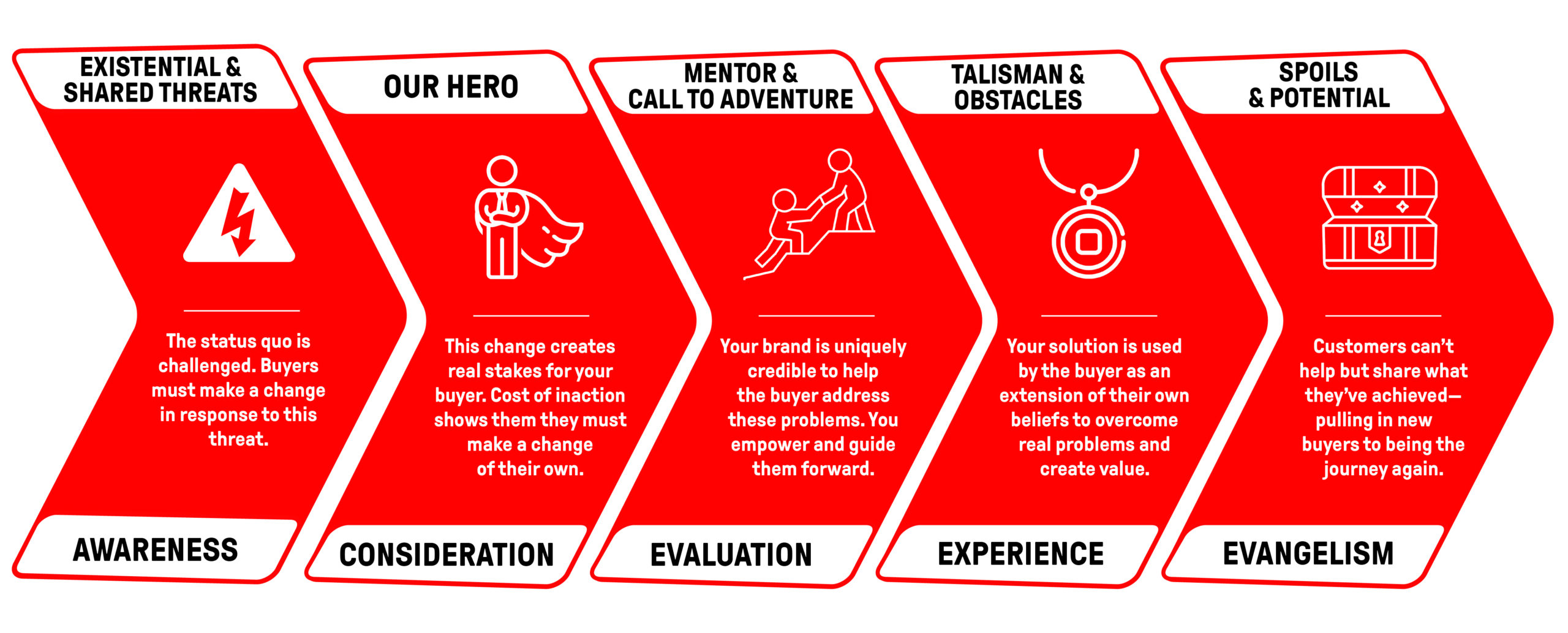
The StoryKernel is a strategic narrative framework you can use to develop your website copy. Every StoryKernel is a “story of change:” it defines why the status quo for your buyer is no longer tenable, presents a defined viewpoint about how the market will operate going forward, and shows why you are the most credible partner to help them.
It distills your brand’s entire strategy down to just a few hundred words. This concentrated view of who you are and the compelling language that goes with it provides the framework from which you can derive both high-converting copy and the specificity needed to engage visitors.
No matter what page your customer lands on, they need to understand your value and positioning quickly. When they can identify your value, they will be pulled to the next stage of the buying journey rather than clicking off your page. That consistency is what the StoryKernel is designed to provide.
Who Is Visiting Your Website, and Where Are They in Their Buying Journey?
The arc of the StoryKernel perfectly mirrors the buying journey. Telling the right story to visitors requires knowing where they are on their journey. Most website projects skip asking who’s actually landing on your homepage, and what do they already know when they get here?
The answer changes everything about how you write.
Awareness
People who land on your website have already passed the awareness stage. They have found your brand, are aware of a problem but may not know a solution like yours exists. They’re reading industry content, searching for answers, trying to name what’s wrong. Good news: if they’re on your site, they’re looking to consider a solution!
Consideration
A B2B buyer who found you through a Google search needs your homepage to do the heavy lifting. This is where your story, positioning, and above-the-fold message either earn conversion or lose the opportunity.
Evaluation
When a buyer is ready to make a decision, they’re combing through your about page, product pages, and case studies, doing due diligence. At this stage, your website needs to deliver credibility, proof, and specifics that confirm their instinct was right.
FletchPMM Provides a Strong Foundation for High Converting Websites
Once you know where your buyer is in the journey, you must write copy to convert them. FletchPMM has helped hundreds of B2B companies improve their homepage positioning. They built a methodology around a deceptively simple idea: weak messaging is almost always a positioning problem, not a copy problem.
If you don’t know exactly who you’re for, what problem you solve, and why your approach is different, your copy will show it. This is where the StoryKernel comes into play. Your StoryKernel identifies who you are and what makes you different and helps you tell that story in a clear and concise manner.
The FletchPMM framework locks down five things before a single word of copy is written:
- Who the product is for: the specific person or team it’s built to serve
- The painful problem: the real friction or cost they’re experiencing today
- The desired outcome: what success looks like on the other side
- The differentiated approach: what makes your solution different from the alternatives
- The category it belongs in: so buyers can instantly contextualize what you are
Their homepage sprints are most effective when a brand is willing to commit to a direction and embrace a broader narrative. Brands who start with the StoryKernel enter any website copy writing (with FletchPMM, another company, or on their own) with the advantage provided by a clear story.
How to Combine the StoryKernel and Fletch’s Framework
Fletch’s framework is a powerful diagnostic and execution tool for your homepage and product pages. When you combine that methodology with the StoryKernel you create effective and unique copy that pulls your ideal buyer towards your business.
Fletch asks you to define your ICP, their painful problem, and your differentiated approach. The StoryKernel uncovers these within your brand, it gives you the narrative arc that connects those positioning elements into a story a buyer can actually see themselves in.
With a strong enough foundation in the StoryKernel, these principles can be applied within your own team, as well.
High-Converting Website Copy: Three Tips
However you’re approaching your website copy, if you’re looking to tell a story that connects with high-intent buyers, there are three things you should keep in mind:
- Simplify Until the Message Is Instantly Understandable
Once you are clear on your story, edit your copy to strip out jargon, abstractions, and internal language. The goal is for someone to “get it” in seconds, without needing industry expertise or prior context. If your mom wouldn’t understand it, it’s not clear enough.
- Lead With Defined Value
Identify the most compelling narrative and build the entire homepage around it. Give visitors a defined viewpoint that tells a story of change. One sharp, relevant narrative does more work than a laundry list of capabilities. Remember, your customers are skimming to find value fast.
- Design Supports Comprehension
Ensure visuals, layouts, screenshots, and headlines all exist to reinforce the message. Push against “pretty but unclear” website design in favor of design where every element serves a purpose.
The StoryKernel as a Solution for Converting Traffic
The StoryKernel starts with a precisely defined ICP and a clear articulation of your differentiators. With those two things locked in, you know which stage your website needs to serve, and you write the message that meets them there.
The StoryKernel addresses converting issues by building the narrative foundation of your website. Pair it with a rigorous approach to positioning and messaging execution, and you have something most brands never achieve: a website that looks and sounds like you, speaks directly to the right buyer, and gives them a reason to stay, scroll, and act.
Having the right messaging will draw your buyer in and pull them through the customer journey.