

The StoryKernel Aligns Teams on EOS and Accelerates Their Growth
For leaders looking to get more out of EOS, the answer is rarely found inside the system itself.
EOS is exceptional at what it is designed to do: showing entrepreneurs how to operate. Its power lies in how its Level 10 meetings create rhythm, its Rocks create focus, and its Scorecards create accountability. Leaders who have been through the process understand firsthand how transformative that internal discipline can be.
No matter how well these systems are executed, leaders running EOS often realize it is not fully translating into the results their business is capable of.
Realizing the full impact of EOS requires a strong story that gets your team aligned around the systems EOS provides for you.
The companies that unlock the most from their EOS implementation are the ones that pair it with a strategic narrative. A single customer-centric story that gives every person in the organization something consistent to carry into every conversation with buyers. When that story is in place, the alignment EOS builds on the inside becomes momentum the market can feel on the outside.
What EOS Is Built to Do
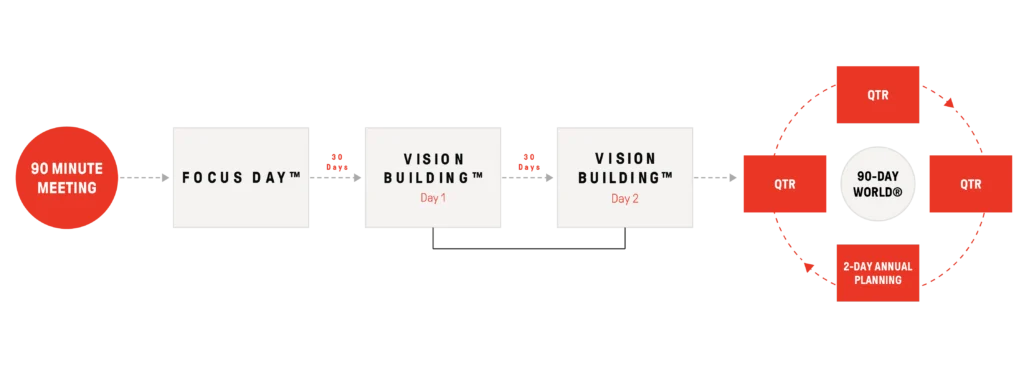
The Entrepreneurial Operating System, developed by Gino Wickman, is one of the most effective frameworks available to growing businesses. Built around six components—Vision, People, Data, Issues, Process, and Traction—EOS gives leadership teams the tools to create accountability, establish a shared vision, and build the operational discipline required to scale.
For thousands of companies, including dozens of Woden’s clients, EOS has been transformational. It brings structure to businesses and creates the conditions for a team to work together with clarity and focus.
What a Strategic Narrative Does
B2B companies require consistent storytelling across every team and touchpoint to reach their goals. Yet misalignment remains one of the most common and costly challenges growing businesses face.
EOS provides tools leadership teams need to create this alignment. What it struggles to provide is the strategy that those tools need to be maximally effective.
When a company deploys EOS, it develops Core Values, Core Focus and a 10-Year Strategy. These are typically hashed out among the leadership team and the results are often generic (and lacking wider input). Most companies that engage Woden following EOS choose to refine their values, three uniques, and other EOS elements.
Combining EOS with a strategic narrative ensures every team member is bought into the company’s strategy, and ready to embrace the structure provided by EOS. Most companies considering EOS choose to begin with the StoryKernel so they enter their first Vision Building Day ready to accelerate.
Why does the StoryKernel, and strategic narrative overall, work so well for EOS companies? The StoryKernel is a story of change that captures a brand’s unique view of what is shifting in its market, positions the customer as the hero navigating that shift, and establishes the brand as the credible guide that helps them reach a new and better world.
This framing helps your team see the foundational elements of EOS from a different perspective. They move beyond generic values like “trust” to capture the unique culture and vision that EOS will make possible.
When every team member is carrying that same story into every conversation, the alignment EOS builds internally becomes visible externally.
The StoryKernel is a strategic narrative framework designed to give growing businesses exactly that foundation. It becomes the source of truth for every message, every conversation, and every piece of content across the buying journey. Paired with EOS, it converts prospects into customers, and customers into evangelists.
The Five Alignment Challenges EOS Companies Face and How the StoryKernel Solves Them
1. The Vision Stays Trapped in the Leadership Suite
- The EOS Pain: Leadership teams invest significant time building out the Vision/Traction Organizer and defining the company’s Rocks. But one of the most widely documented frustrations among EOS practitioners is that the vision rarely cascades with full force to the people who need to carry it. Middle managers and frontline team members experience EOS as a set of directives handed down from above rather than a strategy they own together.
- The StoryKernel Solution: The StoryKernel is uncovered through the input of the entire team. It aligns unique perspectives behind a shared, customer-centric narrative. The resulting story feels authentic to the team and organic to their inputs. This primes them to accept the structure of EOS.
- The Implementation: A strategic narrative translates the company’s vision into a story every employee can internalize and retell. When a team member understands not just what the Rocks are but why those Rocks matter to the customer they are serving, the vision stops living in a boardroom and starts living in every conversation the company has with the market.
2. Rocks Feel Disconnected From the Work That Actually Matters
- The EOS Pain: A common frustration among EOS leadership teams is the tendency for quarterly Rocks treated as a success when they are just 80 percent completed. Over time this creates a backlog of unfinished initiatives, a weakened culture of accountability, and strategic momentum that never fully compounds.
- The StoryKernel Solution: This gap occurs because Rocks are often viewed as isolated internal tasks rather than critical dependencies. The StoryKernel framework reframes these objectives as ways to overcome the obstacles customers face between the status quo and the New World (Potential Achieved) their brand promises.
- The Implementation: When a strategic narrative is in place, every Rock can be mapped back to a specific moment in the customer’s journey. A team member who understands that their quarterly goal is a direct part of the story their company is telling the market approaches their work with a fundamentally different sense of ownership. The customer becomes the reason the work gets finished, not just a name on a slide in a quarterly review.
3. The Visionary and Integrator Are Speaking Different Languages
- The EOS Pain: The dynamic between the Visionary and the Integrator is one of the defining relationships in any EOS-run business. When it breaks down, the Visionary feels constrained by the system and the Integrator feels overwhelmed by a constant stream of ideas that have no clear connection to the current strategy.
- The StoryKernel Solution: The StoryKernel creates a framework to unify long-term vision and daily tactics. The narrative itself is strategic and largely the domain of the Visionary. The story directly connects to the customer journey, the domain of the Integrator. And in between, Woden’s Messaging Hierarchy provides a way to translate the strategic and tactical organization-wide.
- The Implementation: A strategic narrative gives both leaders a common language. The Visionary finds their long-term ambition fully expressed in the arc of the story, from the existential threat facing the market to the potential the customer achieves on the other side. The Integrator finds the guardrails they need in the defined hero, the clear differentiators, and the brand promise that anchors every operational decision.
4. Organizational Change Meets Resistance That Slows Everything Down
- The EOS Pain: Resistance to change is one of the most cited barriers to a successful EOS implementation. Restructuring accountability, introducing new meeting disciplines, and reshaping how the organization operates will create friction. Long-tenured team members who built their identity around the way things used to work can be among the hardest to bring along.
- The StoryKernel Solution: The StoryKernel is designed to help people want to change. The story of change helps your team see why the status quo is no longer tenable, and the new world the story describes comes from team and customer input. EOS can be framed as a tool to realize the story everyone is motivated by.
- The Implementation: A strategic narrative reframes every organizational change as part of a larger story the whole team is telling together. When team members understand that the changes being made are in service of the customer their company exists to help, the transformation becomes something worth being part of rather than something being done to them.
5. The Message Keeps Shifting and the Market Stops Listening
- The EOS Pain: Framework fatigue is a well-documented pattern in growing businesses. When the market results leadership expected do not arrive on the timeline they hoped for, the temptation is to look for the next lever to pull. As messaging shifts, the target market widens or narrows, and positioning changes, every change makes it harder for the market to understand what the company actually stands for.
- The StoryKernel Solution: The StoryKernel acts as one mother story. It forces absolute alignment by ensuring that every piece of messaging, every product pivot, and every sales motion is derived from a single, unchanging narrative arc.
- The Implementation: Because the StoryKernel maps the narrative completely across the customer journey, it creates an enduring blueprint for how the brand shows up in the market. When leadership feels the urge to chase a new trend or shift focus abruptly, the StoryKernel serves as a stabilizer. It ensures the company stays focused on owning a defined viewpoint in the market, providing the long-term narrative consistency required for the EOS execution tools to actually take root and deliver compounding returns.
Give Your EOS a Story to Tell
EOS gives a business the operational foundation it needs to scale with discipline and intention. The leaders who get the most out of it understand that the system is most powerful when every person it aligns has a compelling story to carry into the market.
The alignment EOS builds on the inside becomes the momentum the market feels on the outside. And that momentum compounds every time a team member, a seller, or a customer tells the same story to someone new.
Brands who get the most out of their EOS begin with the StoryKernel. Uncovering their story ensures the elements of EOS defined in their Vision Building Day are authentic and shared company-wide. The StoryKernel guarantees the team is excited for adoption of EOS. And most importantly, it provides a way for them to rally customers and their peers to the strategy EOS is designed to realize.
Whether you’re considering EOS and need a place or start, or are already using it but aren’t getting the traction you imagined, the StoryKernel is where your story begins.