
How to Tell a Great Story Using the Most Popular B2B Sales Methodologies
The linear path led by a single champion that once dominated B2B sales has been replaced by a networked journey. Today’s buyers enter the journey later. They are already shaped by digital research, fragmented information, and bring deep-seated skepticism.
B2B brands who want to grow faster embrace a sales methodology that matches their buying journey. While there are dozens of sales frameworks available, there isn’t just “one right answer.”
Depending on your buyer, product, and go-to-market strategy, a team might borrow the psychological safety of Sandler, the urgency of Gap Selling, or the disruptive insight of the Challenger Sale to meet their specific market needs.
What to Do Before You Pick a Sales Methodology
It’s tempting to jump right into picking a sales methodology and hiring a trainer to implement it. But within each metholodology, sellers win based on the stories they tell.
This is where the StoryKernel provides an ideal foundation. When a brand begins a revamp of their sales strategy by crafting a StoryKernel, they know exactly what is shifting in their market, get clear on their true ICP, and nail precise positioning. The StoryKernel anchors these core elements into a single, actionable framework that is easy for sellers to adapt into their own storytelling.
Most importantly, the structure of the StoryKernel defines how a brand goes to market and dictates both which methodology to deploy and exactly which piece of content to use at each stage. In every case, it ensures that regardless of the framework you choose, your customer remains the core of the story, and every interaction moves toward a clear, impactful change.
The StoryKernel gives you the strategic infrastructure required to implement these methodologies across your entire organization. It bridges the gap between high-level sales theory and real-world execution, equipping your team with the absolute clarity needed to run any chosen framework with maximum precision and force.
By applying the StoryKernel to these six proven methodologies, you can transform your sales motion from a series of disconnected meetings into a unified, customer-centric story that converts.
The Best Sales Methodologies For Your Business
The Challenger Sale
First introduced in the 2011 book The Challenger Sale: Taking Control of the Customer Conversation, this framework disrupted decades of sales thinking. It was born out of the Great Recession to answer a single question: Why did some sellers continue to win during economic uncertainty while others failed?
The framework embraces the reality of the modern B2B buyer. Research shows that most prospects conduct the majority of their research online before ever speaking to a salesperson. They come to the table with preconceived ideas about features and price, making them uninterested in a standard pitch.
In an environment where information is a commodity, the Challenger shines by moving beyond the “Relationship Builder” persona to become a teacher who disrupts the status quo.
According to Gartner’s research, while “Challengers” make up only 23 percent of the sales population, they are responsible for 54 percent of closed-won deals in complex sales cycles. The power of this framework lies in the seller’s ability to act as a “debater” who pushes the customer out of their comfort zone.
How The Challenger Sale Methodology Works
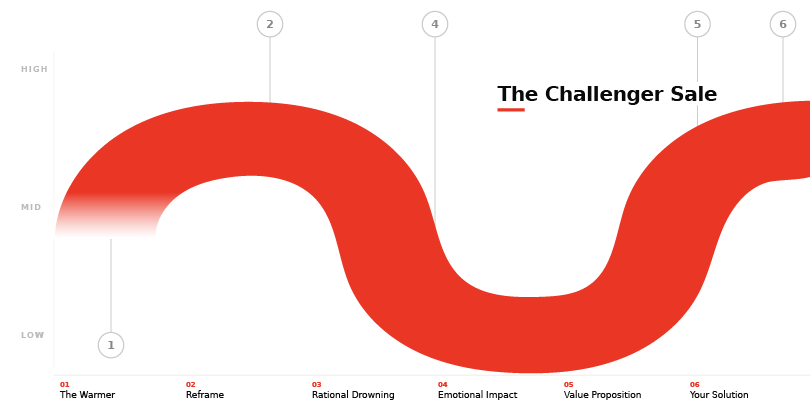
1. The Warmer
Build credibility by demonstrating an understanding of the prospect’s challenges, using industry insights rather than asking “what’s keeping you up at night?”
2. Reframe
Change the customer’s perspective by connecting their pain points to a larger, unknown problem or missed opportunity.
3. Rational Drowning
Introduce data-driven evidence and statistics to convince the customer why this new, larger problem is worth solving (making them “drown” in logic).
4. Emotional Impact
Use stories and testimonials to make the data personally relevant, helping the customer visualize the personal impact of inaction.
5. Value Proposition
Introduce a new, superior solution or path to address the newly identified problem, shifting focus from “what” they are doing to “how” they are doing it.
6. Your Solution
Finally, introduce your company’s specific products or services as the best means to achieve this new path.
The Challenger Pillars: Teach, Tailor, Take Control
To execute these steps, the framework relies on three core capabilities:
- Teach for Differentiation: Challengers provide a unique perspective that disrupts the status quo. They provide commercial insight that teaches the customer how to think differently about their business.
- Tailor for Resonance: They ensure the message is customized for each individual stakeholder. By understanding what drives a CFO versus a CTO, the Challenger ensures the story resonates with each person’s specific goals.
- Take Control of the Sale: Challengers are comfortable with tension. They take control of the process by confidently discussing money and pressing customers for commitments, ensuring the sale doesn’t stall in a consensus limbo.
Advantages Of The Challenger Sale Methodology
- Offers a Unique Perspective
- Deep Value Understanding
- Breaks Complacency
Disadvantages Of The Challenger Sale Methodology
- Skill Dependent
- Complex Sales Only
- Requires Educated Sellers
When to Deploy the Challenger Sale
Innovative or highly technical companies build their StoryKernel around a defined viewpoint. When this approach is used in the strategic narrative, it provides the exact map to help buyers understand why the status quo is no longer tenable, shifting them from an old way of doing things to a completely new paradigm for the future.
The Challenger Sale is ideal for companies like this. If your StoryKernel reveals that you are selling a disruptive solution in a market where buyers think they already know everything, the Challenger framework provides the tools to hit your buyer with that viewpoint at the exact right time.
The Dale Carnegie Relationship Methodology
Born from the need to professionalize sales during the trust-starved era of the 1930s, the Dale Carnegie Relationship Methodology remains the gold standard for high-stakes, long-term B2B sales.
While it originated as a response to the high-pressure tactics of the Great Depression, its principles are still relevant today. In an age of automated outreach and AI-generated pitches, the emotional intelligence in sales needed to build genuine human rapport and “sell trust” has become a rare and premium competitive advantage.
B2B buyers are skeptical of being “sold,” but they are desperate for partners who listen. This methodology centers on dramatizing ideas through storytelling. Carnegie taught that while metrics might get you in the door, feelings move people to act.
By telling stories where the prospect is the hero, sellers can validate the buyer’s struggles and align their solution with the prospect’s “noble motives,” such as protecting their team or leading their industry
How The Dale Carnegie Relationship Methodology Works
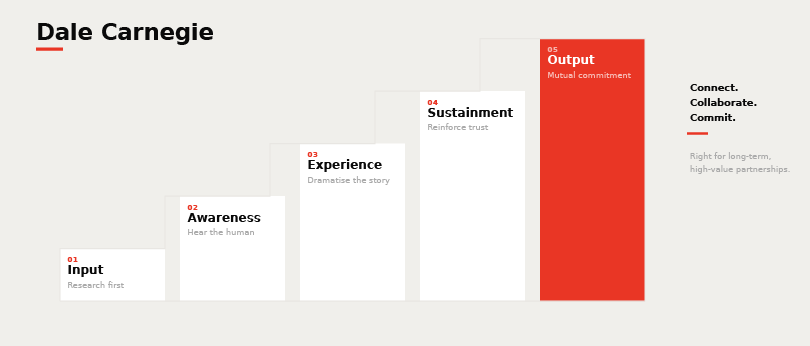
1. Input
The preparation phase. You gather “raw materials” by researching the prospect’s industry and professional drivers to ensure your first point of contact is rooted in their reality, not yours.
2. Awareness
The listening phase. You move from data to human connection by identifying the “human” pain points that sit behind the business problems. You show that you are solving a person’s problem.
3. Experience
This is where you dramatize the idea. You share a vivid story of a similar peer’s struggle and eventual success. You create a shared narrative experience that makes the solution feel inevitable and safe.
4. Sustainment
Reinforcing trust post-narrative. You demonstrate a commitment to the prospect’s long-term success, ensuring the relationship remains the priority over the individual transaction.
5. Output
The final result: a mutual commitment. The output is a partnership founded on trust where the prospect feels heard, understood, and confident in the agreement.
The 3-Step Process (Connect, Collaborate, Commit):
- Connect: Establish rapport and genuine interest, building the foundation of trust.
- Collaborate: Act as a trusted advisor, exploring needs, and uncovering the customer’s “why”.
- Commit: Proposing solutions that specifically address the uncovered needs, leading to a confident, mutual agreement.
Advantages Of The Dale Carnegie Sale Methodology
- Builds psychological safety
- Humanizes data
- Drives customer lifetime value
Disadvantages Of The Dale Carnegie Methodology
- Time intensive
- Requires high levels of emotional intelligence which is hard to train
- Hard to overcome price objections
When to Deploy the Dale Carnegie Methodology
Brands with a heavy service component or high switching costs emphasize credibility in their StoryKernel. The StoryKernel positions the seller as a mentor who can guide the buyer through the customer journey. By mapping out a strategic narrative where the buyer believes you have the exact experience needed to help them navigate a major shift in their world, you form an instant, human connection.
The Dale Carnegie approach thrives on mutual trust, and is ideal if your StoryKernel reveals the need to emphasize long-term, high-value partnerships. This framework ensures your sellers can lead with empathy and authority from day one.
Gap Selling (The “Current vs. Future State” Framework)
Developed by Keenan, CEO of A Sales Guy Inc., and codified in his book Gap Selling, this problem-centric sales methodology challenges the traditional focus on product features. In the world of Gap Selling, the salesperson’s primary job is to influence change by exposing the literal and emotional distance between where a customer is and where they need to be.
Gap Selling is based on two fundamental principles, according to Keenan:
- Nobody buys a product or makes a change unless their current situation is untenable.
- It’s the salesperson’s job to influence that change. They can do that by getting a complete understanding of the customer’s current state and future state before they introduce the product.
In a B2B context, this methodology is the ultimate tool for creating urgency and quantifying the “cost of inaction.” The story here serves as a bridge: a narrative that contrasts a “Current State” story of stress and lost revenue with a “Future State” story of efficiency and growth. The larger the gap between these two stories, the higher the perceived value of the solution.
How The Gap Selling Methodology Works
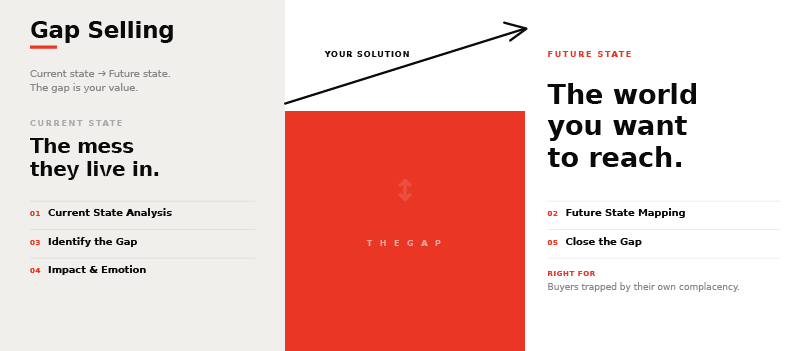
1. Current State Analysis
A deep-dive discovery into the buyer’s status quo. You are looking for the facts, the environment, and the “mess” that defines their world today.
2. Future State Mapping
Defining the “New World.” You work with the buyer to describe exactly where they want to be, focusing on the outcomes they desire rather than the tools they need.
3. Identifying the “Gap”
The difference between the two states is the Gap. This is where the value of your solution lives; if there is no gap, there is no deal.
4. Impact and Emotion
Uncovering the human and business costs of staying put. You translate technical problems into emotional impacts like missed revenue, high turnover, and executive stress.
5. Closing the Gap
Presenting your solution specifically as the tool to bridge the distance. The product is introduced only as the means to cross from the Current State to the Future State.
The Core Principles: Root Cause & Outcome
To execute this methodology, the seller must shift to a “diagnostic” mindset:
- Identify The Root Causes: Most buyers only see the symptoms (ex. low close rates). The Gap Seller digs deeper to find the root causes that are creating the impacts felt across the company.
- Focus on Future State Outcomes: Success is defined by the “Beautiful World” the buyer reaches after the sale. Whether it’s 80 percent of the team exceeding quota or thrilled stockholders, the story stays focused on the outcome.
Advantages Of The Gap Selling Methodology
- Eliminates “No Decision” losses
- Increases deal value
- Shortens sales cycles
Disadvantages Of The Gap Selling Methodology
- Highly confrontational
- Discovery heavy
- Sellers need to understand complex business problems
When to Deploy Gap Selling
When a company needs to make a strong case against the status quo, the StoryKernel and Gap Selling are an ideal 1-2 punch. The StoryKernel is anchored in an Existential Threat: the significant, meaningful shift in the market that makes a buyer’s current situation completely untenable. This makes the StoryKernel the perfect engine for Gap Sellers, as it clearly visualizes the massive distance between a high-stress “Current State” and an optimized “Future State.”
If your StoryKernel reveals that your biggest competitor isn’t another vendor, but rather the buyer’s own complacency and the comfort of the “status quo,” the Gap Selling framework gives your team the diagnostic tools to expose that gap and create immediate urgency.
The Sandler Selling System
Formalized in 1967 by David Sandler, this methodology was a direct reaction to the aggressive, high-pressure “Always Be Closing” tactics of the 1960s. After enduring 87 consecutive failed sales calls, Sandler teamed up with a clinical psychologist to design an approach rooted in mutual respect rather than manipulation. The result was a system that broke the traditional salesperson stereotype, focusing on qualifying decisions through clarity and equal business stature.
When B2B prospects are guarded or “salesy,” Sandler is an essential tool for lowering defenses. The narrative heart of this methodology is the third-party story. Instead of an interrogative discovery, the seller uses externalized narratives to describe a similar peer’s struggle. This allows the prospect to see themselves in someone else’s journey, creating a psychologically safe space for them to admit to their own “Pain” without feeling pursued.
How the Sandler Selling System Works
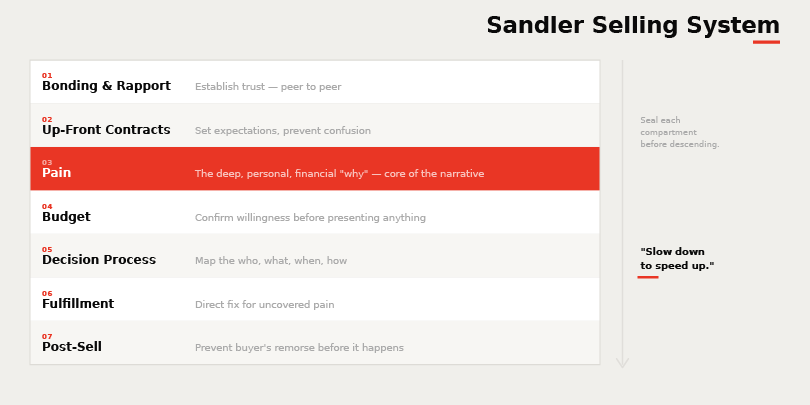
The methodology is organized into seven steps, forming a “submarine” structure where each step is a compartment that must be “sealed” before moving to the next.
- Bonding & Rapport
Establishing trust and equal business stature. You are a peer helping a peer. - Up-Front Contracts
Setting clear expectations for the meeting’s agenda and possible outcomes to prevent “mutual mystification.” - Pain
Uncovering the deep, personal, and financial problems that the prospect is facing. This is the core of the narrative, finding the “why” behind the business issue. - Budget
Determining if the prospect has the resources and the willingness to invest before any solution is presented. - Decision-Making Process
Identifying the “who, what, when, and how” of the buyer’s internal journey to avoid late-stage surprises. - Fulfillment
Presenting your solution as the direct fix for the specific pain points and budget constraints uncovered during discovery. - Post-Sell
Ensuring a smooth transition and preventing buyer’s remorse by addressing potential “aftershocks” before they happen.
Key Principles and Techniques of the Sandler Selling System
- “Slow Down to Speed Up”: The methodology emphasizes not rushing to the presentation or closing, but rather focusing on thorough qualification early on, which results in a faster overall sales cycle.
- Negative Reverse Selling: A unique technique used to cut through noise, such as asking “If I’m hearing you correctly, it sounds like our software might not be a good fit for you right now. Is that right?” to disqualify quickly.
- The “Takeaway”: Reversing the traditional role, where the salesperson might inform the prospect that a deal might not be right for them, which can remove pressure and make the buyer pursue the sale.
Advantages of the Sandler Sales Methodology
- Eliminates sales pressure
- Prevents time-wasting on “unqualified” leads by getting to a “No” quickly
- Establishes the salesperson as an equal partner
Disadvantages of the Sandler Sales Methodology
- Success depends on a salesperson’s ability to handle “Negative Reversing”
- Can feel like a new form of manipulation to sophisticated buyers
- Long learning curve
When to Deploy the Sandler Sales Methodology
When a brand needs to pull buyers on to their side of the table and work a problem together, the StoryKernel outlines the journey. Sandler Sellers can use its structured narrative to ensure the buyer sees their problem clearly, while positioning as the partner who can help them solve it collaboratively. This approach ties perfectly into Sandler’s goal of bringing both people together on equal business stature, transforming an adversarial transaction into a shared mission.
The StoryKernel acts as the strategic engine for Sandler’s “Third-Party Stories,” transforming a simple anecdote into a powerful mirroring tool. By aligning the previous client and prospect as common heroes facing the same Existential Threat, your sellers can use the challenge and conflict phases to externalize the prospect’s own struggles. If your StoryKernel reveals that you frequently deal with guarded prospects or find yourself “chasing” deals that never close, this combination allows buyers to lower their defenses and see themselves in your story without feeling pursued.
The SPIN Methodology
Neil Rackham developed SPIN Selling following a 12-year, $1 million research project by Huthwaite, Inc., to redefine how high-value, complex B2B deals are closed. It moved away from emphasizing closing techniques, arguing that in major sales, the buyer’s needs are rarely clear at the start. Instead, success depends on the seller’s ability to act as a consultant, helping the customer discover and articulate the depth of their own problems.
In a complex deal with multiple stakeholders, SPIN builds a case for change. The narrative power of this methodology lies in the implication story. Rather than telling the customer they have a problem, you ask questions that force them to tell you the story of what happens if they don’t fix it. You are essentially co-authoring a cautionary tale with the prospect, where they become the primary narrator of their own risk.
How The SPIN Selling Methodology Works
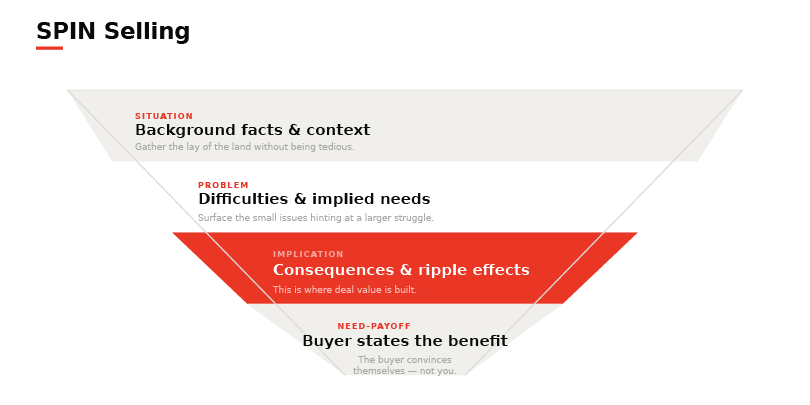
The framework uses a specific sequence of questions to move a prospect from a vague dissatisfaction to a concrete desire for a solution.
1. Situation
Establishing the background facts. These are data-gathering questions intended to help you understand the prospect’s current world without being overly tedious.
2. Problem
Uncovering difficulties and dissatisfactions. These questions identify “implied needs”—the small issues that hint at a larger underlying struggle.
3. Implication
Exploring the consequences and seriousness of the problems. This is where the value of the deal is built. You help the buyer visualize the “ripple effect” of their problem across the entire organization.
4. Need-payoff
Getting the buyer to state the benefits of a solution. Instead of you explaining the ROI, the buyer describes how your solution could specifically make their life better.
Advantages of the SPIN Selling Methodology
- Builds massive value
- The buyer convinces themselves of the need for change
- Ideal for complexity
Disadvantages of the SPIN Selling Methodology
- Outdated “Situation” phase
- Rigid structure
- Requires the mastery of the art of “Implication” questioning without sounding repetitive or scripted
When to Deploy SPIN Selling
The StoryKernel takes big, existential threats to a market and frames them as a shared threat for buyers to overcome. For brands that need to align a buying committee full of stakeholders with differing incentives, it pairs with SPIN Selling to go beyond a generic ROI calculation. The strategic narrative’s clear view of ultimate success is what gives your team the confidence and direction needed to guide prospects through complex, open-ended diagnostic conversations.
If your StoryKernel reveals the need to address many stakeholders and align them on the catastrophic cost of their problems, the SPIN framework is your best tool. It allows you to use your strategic narrative to craft the precise questions that guide the buyer to realize both the stakes of remaining the same and the true value of the transformation ahead.
The Spiced Methodology
A modern successor to SPIN, the SPICED framework was developed by Winning by Design specifically for the SaaS and recurring revenue era. Unlike older models that focus primarily on the initial “close,” SPICED is designed for the entire customer lifecycle. It recognizes that in a subscription-based world, the sale doesn’t end at the signature.
The narrative heart of SPICED is impact. In this framework, the story is about a measurable business outcome and the critical event that serves as the story’s climax. This framework forces the seller to move beyond technical pains to identify the urgent deadline or business milestone that makes change inevitable. It turns the sales process into a race against time, where your solution is the only way for the customer to reach their goal before the clock runs out.
How the SPICED Methodology Works
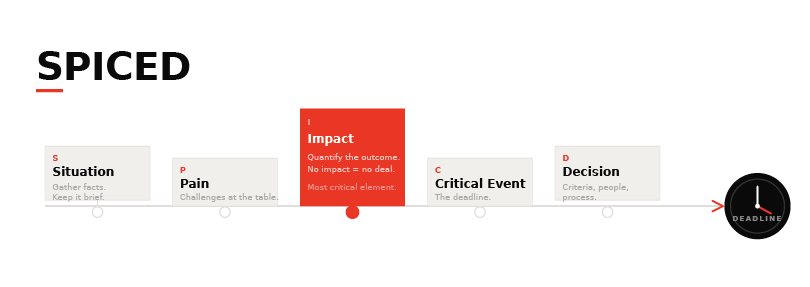
SPICED uses five distinct categories to organize information and drive a customer-centric conversation.
1. Situation
Gathering the relevant facts about the buyer’s business, team, and current tech stack. In the SPICED model, this is kept brief to respect the buyer’s time.
2. Pain
Identifying the specific challenges that brought the buyer to the table. These are the symptoms that indicate a change is necessary.
3. Impact
The most critical element. You quantify the business results the customer expects to achieve. If there is no impact, there is no reason for the buyer to move forward.
4. Critical Event
Identifying the “Deadline.” This is the specific date by which the customer must achieve the impact or face negative consequences.
5. Decision
Understanding the “How.” This covers the decision criteria, the people involved, and the process required to get the deal across the line by the critical event.
Advantages of the SPICED Methodology
- Reduced churn
- Creates natural urgency
- Designed for high-velocity SaaS environments
Disadvantages of the SPICED Methodology
- Outcome dependent
- Sellers must understand their prospect’s executive-level goals
- Less effective for simple sales
When to Deploy the SPICED Methodology
The StoryKernel arc is designed to mirror the buying journey, all the way through Customer Experience and Evangelism. Companies who realize most of their value through retention and increased LTV and use the StoryKernel alongside SPIN to define recurring milestones, long-term impact, and evolving threats a business faces over time.
Pairing SPICED with the StoryKernel ensures your team can continuously track impact, anticipate critical events, and secure predictable retention long after the initial deal is closed.
The Next Step in Your Sales Journey
The six sales methodologies outlined above cannot generate momentum on their own because every methodology requires a pre-established narrative foundation, an accurate ICP, and sharp positioning to work. Before your team can successfully execute a qualification step, discovery question, or understand the threats affecting the buyer, you must first establish your core story and have the right content ready to support it.
This is why you must build your StoryKernel first. The StoryKernel serves as the foundational framework that dictates exactly which methodology to deploy and which piece of content to use at each stage. By defining the overarching shift in your market, nailing down your exact audience, and aligning your positioning, it equips your sales team with the precise strategic context needed to run any chosen framework. This structure ensures your entire team is on the same page, moving your sales motion from a vendor-driven pitch to a predictable, customer-centric journey that consistently drives revenue.
To further explore the impact of narrative on the customer journey download Story is the Strategy, a comprehensive guide for using the StoryKernel and tools designed for B2B brand storytelling.