

How to Align Your Entire Go-to-Market Team Around a Single, Market-Differentiating Story
If other people don’t understand why your brand is valuable, they can’t take the action you want. A brand story motivates prospects to become customers, and it inspires customers and employees to share your story.
Most brands know what makes them unique, but can’t communicate that to others. This guide will show you how to uncover the powerful story within your brand, and share it with the world.
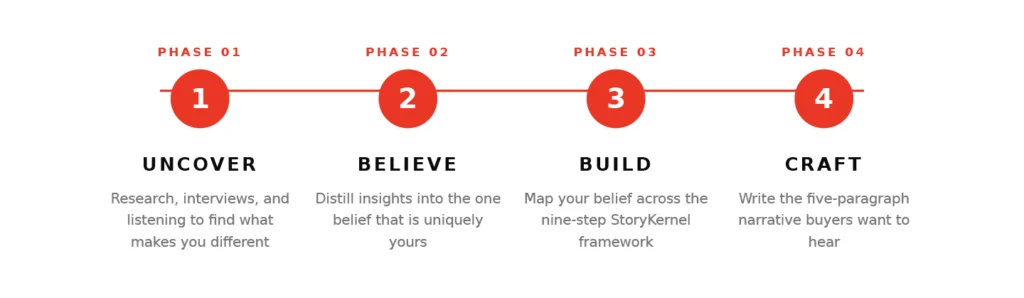
There are four steps to writing a brand story:
- Uncover what makes your brand different
- Commit to a belief statement
- Build the elements of your brand story
- Craft a narrative buyers want to hear
Discover the Story Within Your Brand
Begin by looking at how your brand is already communicating. Your current sales and marketing materials are telling a story. Look at what messages are effective at attracting new customers, and which aren’t. Consider how they have evolved over time and which are most personally resonant to you.
Then, spend some time looking at your market overall. How is it changing? Is it growing? Are there new competitors? Solutions that you don’t offer?
AI can be helpful for market research. Make sure you seek out solutions that are indirect competitors; remember that customers have many alternatives, including inaction, and it’s important to understand how they view the problem your brand solves for.
Once you have a lay of the land, it’s time to listen.
If you’re not the CEO or founder, begin by interviewing them. Your brand story captures not only a moment in time but where the company is heading, so it’s important to get a strategic view of the company’s priorities. Try to uncover the vision, what the company is doing well, and where it needs to change to meet customer needs.
If you’re in this role yourself, have someone else conduct this interview. Interviews should come from a customer perspective, and it’s helpful to have someone challenge existing ideas or approaches.
From there, draw up a list of key internal stakeholders to interviews, such as team members and board members. You can interview as many people as you like, but make sure you get a diversity of perspectives: the best listening includes a mix of long- and short-tenured employees, and both managers and individual contributors.
Then, do the same with external stakeholders such as customers, dealers, and partners. When you talk to each stakeholder, you’ll want to understand why they decided to work with your company, alternatives they considered, what they think makes you different, and any strengths or areas for improvement.
Finally, come back to the CEO or founder for a second interview. Use this time to identify where there is conflicting feedback in the interviews of other stakeholders (including with the CEO’s own answers), and gain consensus on the direction they prefer.
Compelling Brand Stories Are Built On Belief
Once you’ve completed your interviews and research, you’ll have a lot of information to take in: opinions, patterns, contradictions, and stories of impact. Your job now is to make sense of it.
Read back through everything and look for key insights: the things multiple stakeholders said in different ways, the challenges customers are going through, and the strengths that stand out.
Force yourself to distill the three to five points that feel most important from your research. Less is more! Uncovering a brand story requires cutting away excess information to get to the core of what matters most in the brand.
Bring together a team to look at these insights and the quotes or data points that support them. This is the ideal time to spend time brainstorming with others to consider: “what do we believe that no one else in our market does?”
A great way to think about the belief statement is to imagine you fill an auditorium with your customers, team, partners, investors, and even your family. You are pushed onto the stage and need to introduce the brand with one sentence: “We believe…”
What would you say?
Your belief is defined viewpoint about what’s changing in the market. It should speak to how you believe the world will look different going forward; why your company was started in the first place.
This statement must be unique to tell a compelling brand story. To make sure your belief is unique, consider: could your two closest competitors say the exact same thing without anyone blinking? If yes, keep brainstorming.
The best beliefs are both authentic to who your brand is today while challenging the status quo for a better tomorrow. Great stories are about change, and the belief is why you believe your customer must do something different.
Download STORY IS THE STRATEGY
Nine Steps to A Winning Brand Story
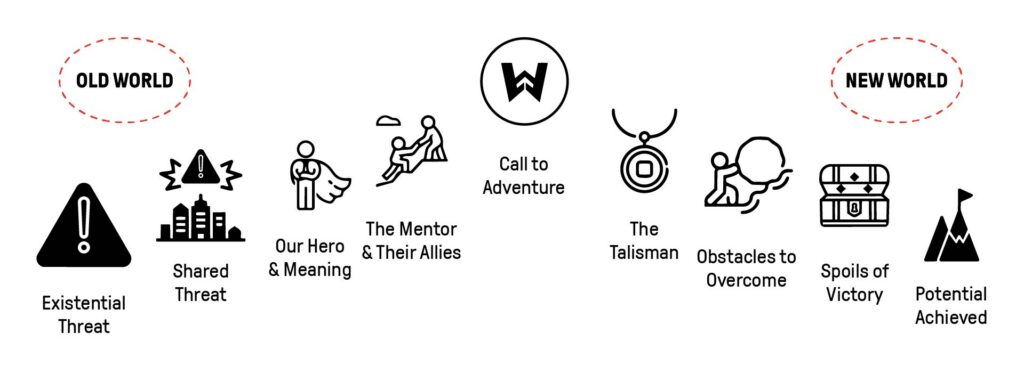
Once you’ve determined your belief, it’s time to write your story!
Woden’s proprietary framework, the StoryKernel, uses nine steps to translate your belief into a strategic narrative: a story of change that shows your buyer why their status quo must change, invites them on a journey to a new world, and shows them the potential they can achieve for themselves there.
Before you actually develop the full story, get your team back together for a brainstorm. Share your proposed belief, and map out the following arc as a story designed to persuade others to share that belief with you:
1. Identify the shift.
Every story begins with a change to the status quo. Your story must give buyers a clear reason to change. Identify why the status quo is no longer tenable; this existential shift is an external factor that divides your story into “the way things were” before the change, and the “way they will be” going forward.
2. Make the stakes tangible.
Consider how the big shift in your story impacts your customers’ business if you’re a B2B company, or their community if you’re a B2C company. Connecting the big change to the lived reality of your buyer’s world creates cost of inaction that compels your customer to make a change.
3. Put your hero at the center of your story.
Your customer must be the hero of your brand story. Define your ideal customer profile, including their challenges, needs, and aspirations. Show how the stakes you’ve set up in your story impact this one specific person, so when buyers hear your brand story they say, “yes, that’s me!”
4. Define what makes you uniquely credible
Your brand’s role is to empower the hero to confront the change in the market head-on. This requires them to trust you and your guidance, so identify what makes you credible. This could include your origin, your team, how you operate, but it’s what shows buyers why they should work with you.
5. Issue a “Call to Adventure”
You must invite buyers to share your belief. Translate your belief into the answer to the question your hero has been building toward: “so, what do I do now?”
6. Introduce your solution.
Show your buyer what your product or service makes possible for your customers. Emphasize how they are transformative and used by customers. Think about the value your best customers have experienced and then work backwards from there.
7. Show how your product empowers customers.
Define a series of obstacles — use cases — customers use solutions to overcome. Show what buyers will need to resolve as they respond to the change in the market, and how they will use your product or service to overcome those challenges.
8. Define the measures of success.
Overcoming these obstacles should come with a clear return on their investment (ROI). Define the outcome of overcoming the threats to their business or community with your brand at their side.
9. Reveal your customer’s potential.
Show your customer that the journey was all worth it. Here, your customers are thriving in the new world with your mentorship. Consider what the world looks like when your customers have overcome the challenges impacting them, their community or business, and the world.
For each of these nine steps, try to narrow down to a single sentence or idea. It will make writing the story much easier.
Writing Your Brand Story
It’s time to write your brand story! Take your outline and in one sitting, write a five-paragraph story from the view of your customer:
Paragraph 1: This is how things are today. But then, something happened! And that change means the way things are won’t work anymore—and it’s impacting businesses like this.
Paragraph 2: There’s one person in the business who feels this most acutely. This hero wants to make a change, but need someone to show them the way.
Paragraph 3: They encounter a credible mentor who shares what they believe about the changes in the market, and reveals what’s possible for the hero if they seek a solution.
Paragraph 4: The mentor gives the hero a talisman they use to overcome obstacles as they navigate towards the new world. The talisman’s magical qualities assure victory.
Paragraph 5: The hero receives tangible benefit from overcoming the obstacles in front of them, and uses them to reach the new world—where the potential of ther brand is achieved.
Try writing the story in the third-person to lend the narrative authority. The first draft may be long; just like you did with the research phase, aim to trim the story down until it’s as tight as possible.
And when it’s ready: share it with your team. The exercise of focusing your entire strategy into just a few hundred worlds will more closely align your team than ever before.
Most importantly, it will focus your value clearly. This brand story will closely resemble a Woden StoryKernel, which means you can use it as a pattern for all of your storytelling across the customer journey.