
This guide covers the most credible alternatives and explains which situations each one was built for.
Why Do B2B Leaders Look for a StoryBrand Alternative?
| Framework | Best For | Core Strength | Why Choose It | Clutch Rating | Pricing |
| StoryBrand SB7 | Small businesses and early-stage brands looking to clarify their homepage and direct response marketing quickly | Seven-part narrative sequence that strips away jargon and keeps the customer at the center of every communication | Best for transactional messaging and short sales cycles where a self-serve template delivers immediate clarity | 4.4 | $275 book / $275-$2,000 online course |
| Woden’s StoryKernel | B2B companies with complex products, multi-stakeholder sales, and teams that need one aligned narrative across every channel | Nine-part strategic narrative built through six weeks of deep research that aligns every team member and produces a full Messaging Hierarchy | The only framework built specifically for B2B go-to-market alignment across sales, marketing, and leadership, not just homepage copy | 4.9 | From $13,500 |
| Andy Raskin’s Strategic Narrative | Venture-backed CEOs who need leadership-level alignment around a high-level narrative and have the internal team to execute | Five-step framework anchored in naming a big market shift that makes the buyer’s status quo untenable | Built for C-suite alignment and pitch narratives rather than transactional homepage copy | Not listed | $100,000+ per engagement |
| The Hero’s Journey | Brands looking for a timeless narrative structure to build purpose-driven storytelling and long-form content around | Universal narrative arc rooted in transformation that resonates across cultures and contexts | Deeper emotional resonance and transformation narrative versus StoryBrand’s transactional structure | Not listed | Free framework |
| The Golden Circle | Leaders who want to anchor the brand in a compelling why before building the full go-to-market narrative | Purpose-first framework that differentiates brands on belief rather than features or price | Builds emotional loyalty and purpose-driven positioning rather than just message clarity | Not listed | $200,000+ for live keynote |
| PitchKitchen | Founder-led B2B companies between $5M and $75M ARR that need narrative plus marketing assets in one fixed-price engagement | 90-day sprint that delivers a Magnetic Messaging Framework, rebuilt homepage, sales deck, AI Brand Twin, and trained sales team | Takes Raskin-style narrative thinking and works it into every asset the sales team uses, including AI | Not listed | $25,000-$45,000 per sprint |
| April Dunford’s 5-Component Positioning Framework | B2B tech companies that need to nail their positioning before building the narrative around it | Five-component positioning framework that identifies the best possible context for a product in the market | Produces the positioning clarity that makes every other framework work better | Not listed | $80,000-100,000 Workshop |
Donald Miller’s StoryBrand is one of the most well-known storytelling frameworks. For small businesses, it delivers a simple way to keep them focused on their customers at a reasonable cost. But for B2B leaders navigating complex sales cycles, multi-stakeholder buying committees, and markets where differentiation is a survival requirement, StoryBrand’s transactional simplicity often falls short.
StoryBrand’s SB7 framework operates on a single principle: customers buy the products they can understand the fastest. It is built around a seven-part story sequence that strips away corporate jargon and creates an immediately scannable message for homepages, email funnels, and landing pages.
Most B2B or larger brands find that StoryBrand’s design around a single customer making a relatively quick purchasing decision doesn’t align with their need for aligning multiple stakeholders, differentiating in competitive markets, or clarifying complex value. When a story needs to go beyond marketing, a framework built for homepage copy has trouble carrying that weight.
If your brand has unsuccessfully tried a StoryBrand BrandScript or if you think your story is unique and complex, you might be exploring storytelling frameworks that feel like a better fit for your brand. This article describes the top four alternatives to consider.
Why Trust Us
Woden has been building strategic narratives for B2B brands since 2012, five years before Building a StoryBrand was even published. Across 300 engagements, Woden has helped companies including Streamline Health, who used Woden after trying StoryBrand.
“We wanted to simplify the way our brand shows up in the market, including clarifying various differentiators and our position within the market.”
—Ben Stilwill, CEO of Streamline
The StoryKernel, Woden’s proprietary nine-part strategic narrative framework, is what’s behind Streamline’s outcome. Our perspective on StoryBrand is from working with clients who have tried it every day.
What is StoryBrand?
The StoryBrand SB7 framework is a storytelling approach created by Donald Miller, introduced in his book Building a StoryBrand. It operates on the principle that customers do not buy the best products but the ones they can understand the fastest. The framework focuses on clarifying brand messaging by removing noise and keeping the customer at the center of every communication.
Built around a seven-part narrative sequence drawn from classic storytelling, StoryBrand gives companies a repeatable structure for their homepage, email funnels, and landing pages. It forces brands to stop talking about themselves and lead with the customer’s problem, positioning the brand as the guide with a plan that helps the customer avoid failure and reach success.
For small businesses, early-stage companies, and brands with a straightforward product and a short sales cycle, StoryBrand is a proven and effective tool for establishing a baseline of clear, customer-centric messaging quickly.
Why Should You Consider an Alternative to StoryBrand?
Building a StoryBrand is a best-selling book, but by compressing a brand’s value into its most transactional form, StoryBrand’s “fill in the blanks” approach often leaves that strategic value invisible to the market.
Research from Bain and Company shows that B2B buyers who understand the full strategic value of a solution are significantly more likely to pay a premium and stay loyal over time. HB2B leaders explore alternatives because:
- The framework follows a rigid, fill-in-the-blank structure. StoryBrand’s seven-part sequence is designed to be applied as a template, which makes it fast to deploy but limits how precisely it can capture the nuance of a complex B2B brand. When every company follows the same script, the output starts to sound identical across competitors in the same market.
- The framework does not account for the buying committee. B2B purchasing now involves an average of six to ten stakeholders, each arriving with different priorities, objections, and definitions of value. A framework designed to capture one customer’s immediate transaction lacks the depth to travel through that committee.
- The framework focuses on external copy rather than getting your team aligned. StoryBrand is typically applied to marketing collateral. Without a deeper organizational narrative, sales, marketing, product, and leadership naturally drift toward different versions of what the brand stands for, and growth stalls.
- The framework leaves brands vulnerable to price pressure. When a narrative is built entirely around features and localized outcomes, competitors with a lower price and a similar feature set can challenge it directly. The strategic market position that commands a premium is rarely visible in a seven-part homepage script.
- The framework is difficult to apply beyond the homepage. StoryBrand gives teams a clear structure for direct response marketing assets but provides limited guidance on how to translate that narrative into a sales motion, a product positioning conversation, or an internal alignment tool that scales across the organization.
StoryBrand Alternatives Worth Considering in 2026
Not every company may need an alternative to StoryBrand for the same reason. Some need a framework built for complex B2B sales. Others need a deeper organizational narrative that aligns the full team rather than just the marketing copy. And some need a story rooted in a market shift rather than a customer problem. The alternatives below each solve a different version of that gap.
| Framework | Best For |
| Woden’s StoryKernel | B2B companies with complex products, multi-stakeholder sales, and teams that need one aligned narrative across every channel and conversation |
| Andy Raskin’s Strategic Narrative | Venture-backed CEOs who need leadership-level alignment around a high-level narrative and have the internal team to translate that strategy into execution |
| The Hero’s Journey | Brands looking for a timeless narrative structure to build purpose-driven storytelling and long-form content around |
| The Golden Circle | Leaders who want to anchor the brand in a compelling “why” before building the full go-to-market narrative |
| Pitch Kitchen | Founder-led B2B companies that need a strategic narrative with a focus on marketing execution in a single sprint |
| April Dunford’s 5-Component Positioning Framework | B2B tech companies that need to nail their positioning |
Woden’s StoryKernel
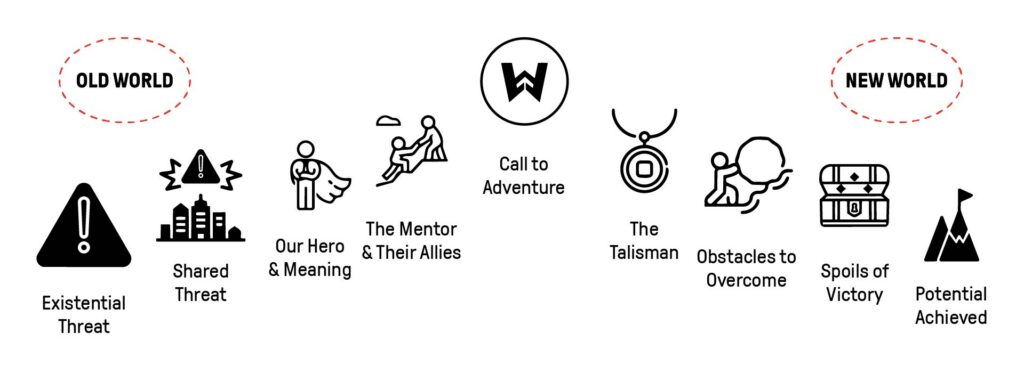
Best for: Strategic B2B leaders who need to align their teams, navigate multi-stakeholder buying committees, differentiate from competitors, or communicate the value of a complex product.
The StoryKernel is Woden’s proprietary strategic narrative framework, built specifically for B2B companies that need a story capable of traveling across every team, every sales conversation, and every stage of the customer journey. Rather than a self-serve template, it is built through six weeks of deep research into a company’s customers, employees, competitors, and market, producing a nine-part, customer-centric narrative that becomes the mother story for everything the brand communicates.
“Working with Woden was a genuinely transformative experience for our organization.”
—Adam Knox, CRO, Revive Health | Read the full review on Clutch
How It Tells Your Story
- Opens with an Existential Threat, an unavoidable shift in the market that makes the buyer’s current way of operating untenable
- Positions the customer as the hero navigating that shift and the brand as the credible guide
- Builds a nine-part narrative arc that travels through every stage of the buying journey without losing its shape
- Produces a Messaging Hierarchy that gives every team member the precise language to describe the brand’s value at every touchpoint
- Anchors every sales conversation, marketing asset, and leadership communication in the same story
Key Features
- Nine-part strategic narrative framework built through six weeks of deep research
- Interviews with customers, employees, competitors, partners, and investors
- Complete Messaging Hierarchy derived from the narrative
- Designed for five or more years of narrative consistency
- Backed by Woden’s guarantee: if we do not uncover what makes your brand essential, we will refund the full fee paid
- Powered by StoryEngine, Woden’s AI platform that eliminates narrative drift and puts the story at every employee’s fingertips
What It Has That StoryBrand Doesn’t
The StoryKernel solves what StoryBrand was never designed to address. It gives every person in the organization one precise story to carry into every conversation, builds a narrative that travels through a multi-stakeholder buying committee without losing its shape, differentiates from competitors within the story itself, and establishes the cost of inaction as a central narrative device that creates urgency grounded in a real market shift.
See what Woden clients are saying on Clutch. | Connect with Woden on LinkedIn.
The Golden Circle
Best for: Leaders who want to anchor the brand in a compelling purpose and build emotional loyalty before developing the full go-to-market narrative.
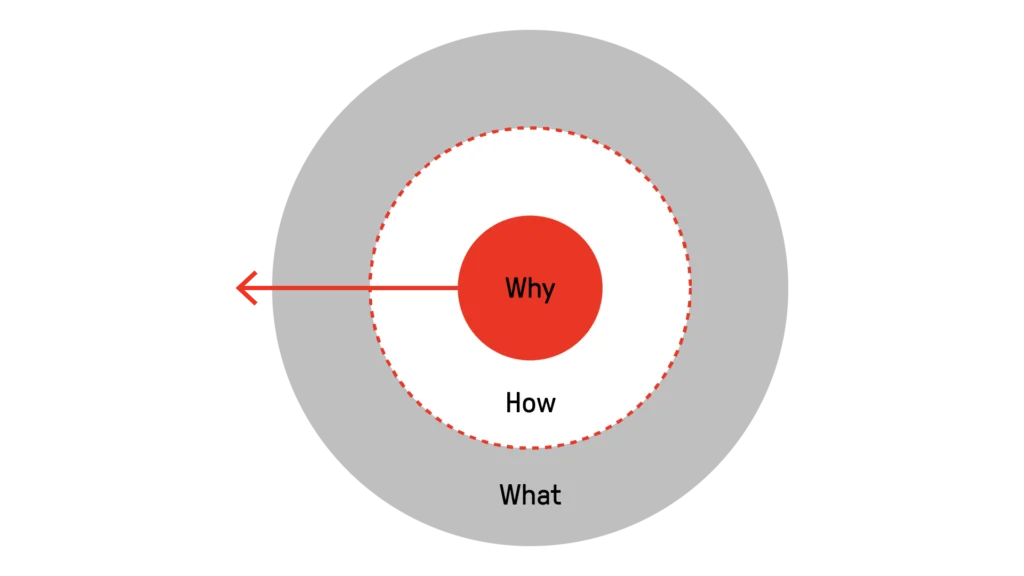
Simon Sinek introduced the Golden Circle in his 2009 TED Talk and subsequent book Start With Why. The framework challenges organizations to communicate from the inside out: Why, then How, then What. It is built on the observation that most companies lead with what they do, while the most influential brands in the world lead with why they exist. The framework has become one of the most widely referenced models in leadership and brand strategy.
“Simon Sinek does a great job breaking down what separates average leaders from the ones people actually want to follow. The whole concept of starting with “why” sounds simple, but it really changes how you think about leadership, decision making, and even communication”
—Brooke T
How It Tells Your Story
- Starts with Why—the core belief or purpose that drives the organization beyond profit
- Moves to How—the specific actions and principles that bring that belief to life
- Closes with What—the products, services, or outcomes the organization delivers
- Builds emotional loyalty by connecting with buyers on the level of shared belief
- Creates differentiation through purpose rather than features or price
Key Features
- Simple, memorable three-part framework accessible to any organization at any stage
- Strong foundation for leadership communications, culture building, and purpose-driven positioning
- Widely available through the book, TED Talk, and online courses
- Applicable across industries and organization types
- Simon Sinek live keynotes start at $200,000 and above
Where It Falls Short
The Golden Circle is a powerful philosophical foundation but lacks the tactical structure required to navigate complex B2B sales objections, differentiate from competitors within the story, or produce the kind of organizational alignment a scaling team needs across every customer touchpoint. It answers why the organization exists but does not give the sales team the precise language to carry that why into a multi-stakeholder buying committee.
See reviews of Start with Why: How Great Leaders Inspire Everyone to Take Action.
Andy Raskin’s Strategic Narrative
Best for: Venture-backed CEOs at growth-stage companies who need leadership-level alignment around a high-level narrative and have the internal infrastructure to translate that strategy into execution.
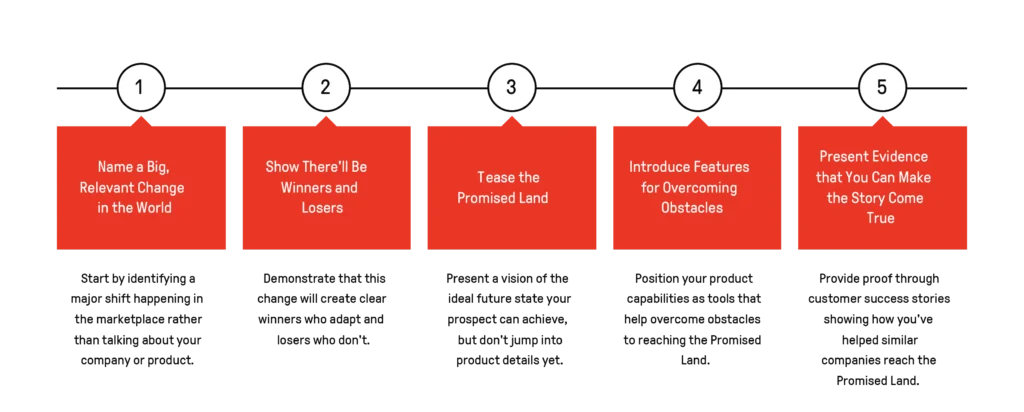
Andy Raskin is a strategic narrative consultant whose clients have included Salesforce, Gong, Dropbox, Uber, and Intercom. His framework, made famous through his viral analysis of Zuora’s pitch deck, is built on the insight that great pitches do not lead with product, problem, or vision. They lead with a change in the world. His five-step approach has become the canonical reference for modern B2B sales narrative at the leadership level.
“Andy crafted new positioning and messaging for Amplitude that immediately increased our win rate and helped us gain traction faster with investors. We were really lucky to work with Andy, and I highly recommend him.”
—Spenser Skates, CEO and Founder Amplitude
How It Tells Your Story
- Opens by naming a big, relevant, and undeniable shift in the buyer’s world
- Shows winners and losers to create urgency through loss aversion and desirability
- Teases a promised land that is improbable without the brand’s guidance
- Introduces features as magic gifts that help the hero overcome obstacles to the promised land
- Closes with evidence last, after the story has already been believed
Key Features
- Five-step framework optimized for leadership alignment and high-stakes pitch narratives
- Built around the concept that CEOs must inspire both their own team and the organizations they sell to
- Deep expertise in venture-backed and enterprise-scale go-to-market narratives
- Highly selective engagement model working directly with CEOs and senior leadership
- Engagements start at $100,000 and above
Where It Falls Short
Raskin’s framework is designed for a specific moment: the leadership-level alignment conversation for large, VC-backed companies. It produces a narrative but not the organizational infrastructure to live it. How the story gets translated into sales conversations, marketing content, customer success touchpoints, and internal culture is left to the client. For companies where narrative consistency across the full organization is the core challenge, the strategy without the implementation path is only half the solution.
The Hero’s Journey
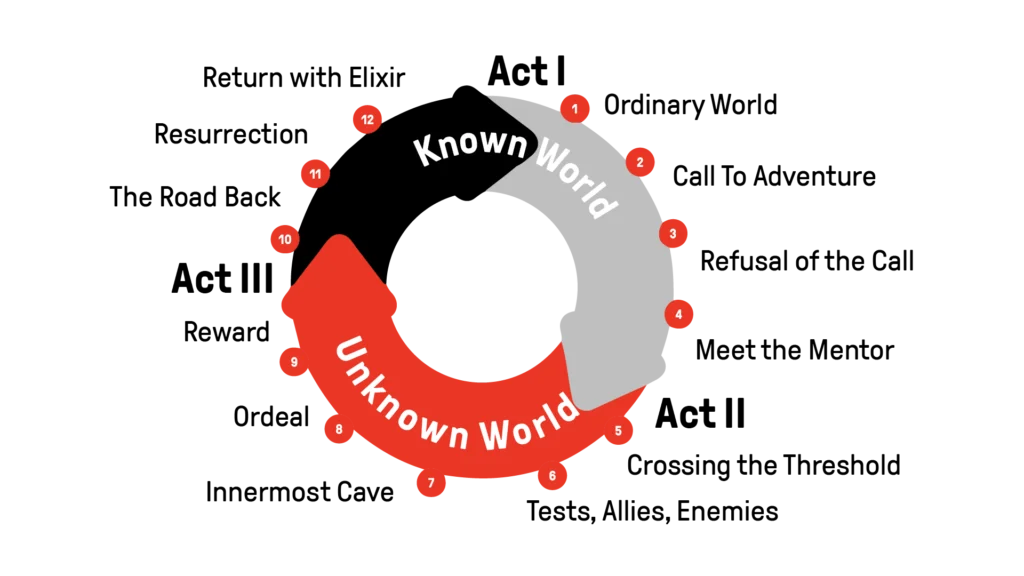
Best for: Brands looking for a timeless narrative structure to build purpose-driven storytelling, long-form content, and emotionally resonant brand communications around.
The Hero’s Journey is one of the oldest and most universal narrative frameworks in existence, identified by mythologist Joseph Campbell in his 1949 work The Hero with a Thousand Faces. It maps a protagonist’s transformation through departure, initiation, and return, and has since been applied to brand storytelling as a way to build deeply resonant narratives that connect with audiences at an emotional level.
How It Tells Your Story
- Positions the customer as the hero departing from their ordinary world into a transformed one
- Builds narrative tension through trials, obstacles, and moments of crisis
- Establishes the brand as a mentor or ally that equips the hero for their journey
- Creates emotional resonance through transformation rather than transaction
- Works as a supplementary structure for case studies, brand films, and keynote storytelling
Key Features
- Timeless, universally recognized narrative structure applicable across cultures and contexts
- Strong foundation for long-form brand content, video storytelling, and purpose-driven communications
- Freely available and widely documented across books, courses, and brand storytelling literature
- Flexible enough to adapt to a wide range of brand voices and industries
- No cost to access the framework itself
Where It Falls Short
The Hero’s Journey is a narrative structure, not a go-to-market framework. It does not produce the organizational alignment, the Messaging Hierarchy, or the precise sales language a scaling B2B team needs to carry a consistent story into every buyer conversation. It is most powerful as a supplementary tool layered on top of a more operationally complete strategic narrative.
Pitch Kitchen
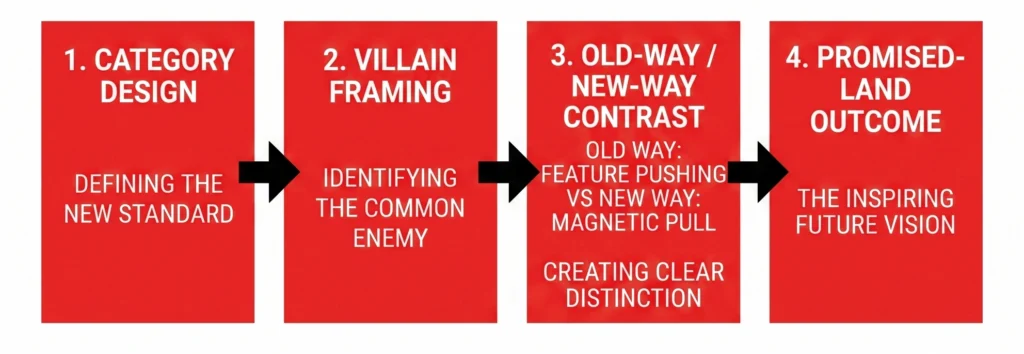
Best for: Founder-led B2B companies between $5M and $75M ARR whose sales are stalling because the message is not doing the work and who need narrative plus execution delivered in a single fixed-price engagement.
PitchKitchen was founded by Greg Rosner, author of StoryCraft for Disruptors, and builds Magnetic Messaging Frameworks for founder-led B2B companies. Its 90-Day Magnetic Messaging Sprint takes the narrative thinking behind frameworks like Andy Raskin’s and ships it directly into the assets a sales team uses every day, including a rebuilt homepage, a redesigned sales deck, and an AI Brand Twin deployed across OpenAI, Gemini, and Claude.
“PitchKitchen has this down to a science, thanks to building so many B2B SaaS homepages. Process was buttoned up and the results were indisputably a game changer.”
— CEO, B2B SaaS Company | See PitchKitchen reviews
How It Tells Your Story
- Builds a Magnetic Messaging Framework that resets the brand’s position and the transformation it sells
- Delivers a story-driven homepage as a finished, published website not a wireframe or mockup
- Produces a Discovery Prompter sales deck that guides the buyer through the narrative
- Trains an AI Brand Twin deployed across OpenAI, Gemini, and Claude with the brand’s specific story
- Includes sales training so the team can deliver the new narrative in customer conversations
Key Features
- 90-day fixed-price sprint
- All deliverables included: framework, homepage, sales deck, AI Brand Twin, email sequences, and sales training
- AI-native execution with a dedicated agent trained on the client’s specific Magnetic Messaging Framework
- Monthly Open Kitchen subscription available at $4,995 per month for ongoing execution
Where It Falls Short
PitchKitchen is primarily positioned for B2B SaaS and tech companies in the $5M to $75M range. Its 90-day sprint model is designed for speed and execution rather than the deep organizational research and change management that a complex multi-stakeholder B2B company needs to align an entire workforce behind one story. For companies that need the narrative to travel across a large organization for five or more years, the sprint model may not produce the depth of organizational alignment it is designed to create.
April Dunford’s 5-Component Positioning Framework
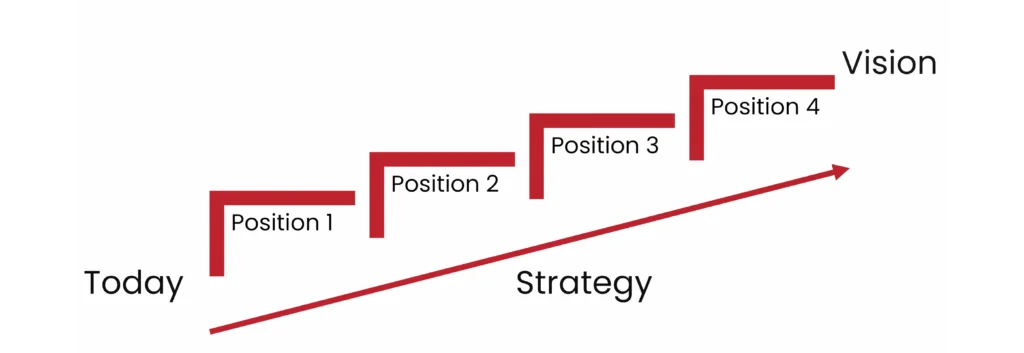
Best for: B2B tech companies that need to nail their product positioning before building the strategic narrative around it.
April Dunford is a positioning expert and author of Obviously Awesome, which has become a foundational text for B2B tech companies trying to understand where their product belongs in the market and why it is genuinely different from alternatives. Her framework is built on the observation that most companies have a positioning problem. Until they understand the best possible context for their product, no amount of narrative work or copywriting will produce the clarity they are looking for
“April’s approach helped our leadership team and sales and marketing team align around our differentiated value for the first time, finally moving from a feature focus.”
— CEO, B2B Tech Company | See Obviously Awesome reviews on Amazon
How It Tells Your Story
- Identifies the competitive alternatives buyers are actually comparing the product against
- Uncovers the unique capabilities the product delivers that alternatives cannot
- Defines the value those capabilities create for a specific set of buyers
- Places the product in the market category that makes those capabilities obviously valuable
- Produces a positioning document the full leadership team can align behind
Key Features
- Five-component positioning framework: competitive alternatives, unique capabilities, value for buyers, target customer characteristics, and market category
- Built for B2B tech companies with complex products in crowded markets
- Designed to be completed collaboratively with the full leadership team, not just marketing
- Delivered through direct, 1:1 consulting engagements with Dunford herself
Where It Falls Short
Dunford’s framework produces exceptional positioning clarity but stops there. While it defines exactly where your product belongs in the market, it doesn’t give your organization a clear way to communicate that consistently or a system to keep the entire team fully aligned to it. It does not produce the narrative arc that carries a buyer through a complex sales process, leaving sales and marketing to interpret the positioning on their own. This is exactly why it is most powerful as a foundation that a deeper framework like Woden’s StoryKernel builds on top of taking static positioning and transforming it into an active, unified story that every team member is equipped to execute.
PitchMaps

Best for: B2B companies navigating mergers or new market entries that need a narrative infrastructure aligned across every team member and every go-to-market asset.
PitchMaps is a B2B messaging system built specifically for Private Equity-backed companies selling in environments where prospects are skeptical, and solutions are complex. Built around the Cause, Villains, and Pillars, the PitchMap framework moves beyond high-level brand positioning to create a narrative infrastructure that aligns every team member around a single consistent conversation. It is built on the creative multiplier principle, which uses advertising techniques to make technical B2B messages sticky and memorable, prioritizing evidence-based research over creative guesswork.
For B2B leaders navigating major organizational changes like mergers, acquisitions, or new market entries, PitchMaps is a strong tool for producing a consistent suite of go-to-market assets quickly.
“PitchMaps helped us align our entire sales team around one story for the first time. Every rep walked into every conversation with the same language.”
—VP of Sales, B2B Technology Company | See PitchMaps
How It Tells Your Story
- Built around three narrative pieces: Cause, Villains, and Pillars
- Uses the creative multiplier principle to make complex B2B messaging memorable and repeatable
- Designed specifically for skeptical buying environments where technical solutions need to be made accessible
- Produces a consistent suite of physical go-to-market deliverables aligned to the same story
- Particularly effective for organizations going through mergers, acquisitions, or new market entries
Key Features
- Evidence-based research methodology rather than creative guesswork
- Built exclusively for B2B companies with complex products and skeptical buyers
- Strong track record with organizations navigating major structural or market changes
- Focuses on producing a full suite of consistent go-to-market assets rather than a single deliverable
- Custom pricing based on engagement scope
Where It Falls Short
PitchMaps is primarily focused on physical deliverables and the consistency of go-to-market assets. For companies that need the narrative to travel across a large organization over five or more years, maintaining that consistency requires ongoing internal governance that PitchMaps does not provide. It does not include the organizational change management, the ongoing coaching, or the AI infrastructure required to keep every team member telling the same story as the organization scales.
Choosing the Right Framework
StoryBrand is proven and effective for small businesses, service providers, and early-stage companies looking to establish a baseline of clear, customer-centric marketing messaging quickly. The right alternative depends entirely on what your organization needs most right now:
- Aligning Large Buying Committees or Internal Teams > StoryKernel, PitchMaps
- Launching Your Small Business > StoryBrand, Hero’s Journey
- Explaining Complex Products > StoryKernel, Andy Raskin, Pitch Kitchen, April Dunford
- Quick Marketing Wins > StoryBrand
- Finding Purpose Beyond Product > Golden Circle
- CEO-Level Messaging > Andy Raskin, StoryKernel
If you are a strategic B2B leader whose product requires the market to think differently about an existing problem, whose team is not telling a consistent story, or whose brand is losing deals to competitors with a lower price and a similar pitch, Woden’s StoryKernel is built exactly for you.
The StoryKernel guarantees others see your value the same way you do. More than 300 l B2B brands have used their StoryKernel to win more best-fit buyers for less. Want buyers to understand what makes you different?