
PitchMaps’ strategic narrative methodology is an approach to B2B messaging and positioning built on a three-phase process the firm calls Uncovery, the PitchMap, and Activation. PitchMaps has built a client roster of PE-backed companies, Fortune 500 firms, and global enterprises, closing what it calls the “clarity gap” between complex, deja-vu, or mixed messaging and a message that actually lands. PitchMaps’ approach centers on an emotionally resonant core message, a Villain, a Gamechanger, and a Rally Cry, rather than a distinct viewpoint and market position.
This has real limitations for B2B leaders who need more than a marketing-focused message. Naming a Villain may sound compelling, but the reality is that structure is too basic to form a defensible market position for a complex B2B sale. Also, the PitchMaps framework doesn’t give an organization the infrastructure to keep a narrative consistent for years after the engagement ends.
This guide covers the most credible alternatives and explains which situations each one was built for.
WHO DO B2B TECH LEADERS LOOK FOR AS A PUNCHY ALTERNATIVE?
| Framework | Best For |
| Woden’s StoryKernel | B2B companies with complex products, buying committee sales, and teams that need one aligned narrative across every channel and conversation |
| Andy Raskin’s Strategic Narrative | Venture-backed CEOs who need leadership-level alignment around a high-level narrative and have the internal team to execute |
| April Dunford’s 5-Component Positioning Framework | Venture-backed CEOs who need leadership-level alignment around a high-level narrative and have the internal team to execute |
| StoryBrand | You’re a small business or early-stage brand that just needs cleaner homepage and sales copy, fast |
| FletchPMM | You’re a SaaS company that needs homepage positioning locked down before building anything bigger |
At the center of PitchMaps’ methodology is a distinction between Company and Cause. A Company message informs by listing what you do, how many markets you serve, and how many years you’ve been doing it. A Cause inspires by identifying a rally cry and a stake in the ground that gives buyers and employees a reason to believe in something beyond the product. PitchMaps argues that 86% of companies are stuck in Company mode, and the Uncovery process exists to pull them out of it.
The output of Uncovery is three things: a Cause, a Villain, and Pillars. The Cause is the brand’s purpose and point of view. The Villain names the real challenge the buyer is up against, the force in the market working against them. The Pillars are a trio of differentiators the brand owns. Together, these three elements become the core of the PitchMap, translated into scripts, stories, and sayings across every major customer touchpoint.
Why Trust Us
Woden has also been building strategic narratives for B2B companies since 2014. Over 12 years and more than 300 StoryKernel engagements, Woden has helped companies navigate the same positioning-to-narrative gap that leads many B2B leaders to look past a PitchMaps engagement.
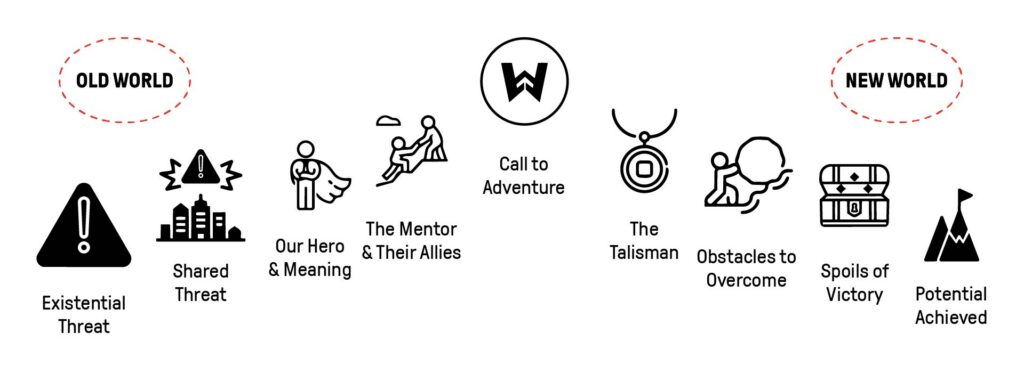
The StoryKernel, Woden’s proprietary nine-part strategic narrative framework, is what takes storytelling to the next level and generates long-term impact.
What Is the PitchMap Approach to Strategic Narrative and Positioning Methodology?
PitchMaps was founded with a singular focus: to help companies communicate their value more clearly. Its clients range from PE-backed middle-market companies to Fortune 500 firms, including Cyderes, Heartland, and Basware, and its engagement runs through three phases:
- Uncovery, an executive strategy session, frontline interviews with sales and customers, and a competitor message analysis that together surface a company’s core message, its Villain, Gamechangers, and Rally Cry
- PitchMap, which builds that core message into a full suite of market-ready messaging mapped across sales enablement, marketing, customer experience, employer branding, investor relations, and product strategy
- Activation, ongoing sessions with a client success consultant to help the organization roll the new message out internally and to the market
For B2B leaders whose messaging has become complex, generic, or inconsistent across the team, PitchMaps’ approach is effective at cutting through the noise with an emotionally resonant core message..
Why Should You Consider an Alternative to PitchMaps?
PitchMaps’ methodology is excellent at building an emotionally resonant core message. But B2B leaders who complete a PitchMaps engagement consistently run into three gaps:
- It delivers messaging elements but not a cohesive story. PitchMaps’ Uncovery phase does surface competitive intelligence and differentiators. But the output — a Cause, a Villain, and a set of Pillars — is a collection of components without a true narrative. There’s no arc that connects them, no sequence that moves a buyer from problem to resolution, and no through-line that tells the organization how the pieces fit together.
- It ends at Activation, with no built-in infrastructure to sustain it. Once the three phases wrap, the organization is on its own to keep the message consistent as the market, the team, and the competitive landscape change in the years that follow.
- It’s scoped and priced for large, well-resourced organizations. PitchMaps’ client examples are almost entirely PE-backed companies, Fortune 500 firms, and global enterprises, and typically costs over $50,000. That leaves smaller or founder-led B2B companies with little sense of whether the engagement fits their budget or stage.
5 PitchMaps Messaging Alternatives Worth Considering in 2026
If you’re looking at PitchMaps, you already know you have a messaging problem. Your story isn’t landing the way it should, your team isn’t telling it consistently, or you’re losing deals to competitors with a sharper pitch. The goal is the same for everyone in that position: messaging that’s memorable, differentiated, and built to last. Where the alternatives diverge is in how they get you there, how deep they go, and whether the story they build is one your whole organization can actually sustain.
| Framework | Best For | Core Strength | Why Choose It Over Andy Raskin | Clutch Rating | Pricing |
|---|---|---|---|---|---|
| Woden’s StoryKernel | B2B companies with complex products, multi-stakeholder sales, and teams that need one aligned narrative across every channel | Nine-part strategic narrative built through six weeks of deep research that aligns every team member and produces a full Messaging Hierarchy | The only framework that connects emotional resonance to a defensible market position and builds the organizational infrastructure to keep the story consistent | 4.9 | From $13,500 |
| Andy Raskin’s Strategic Narrative | Venture-backed CEOs who need leadership-level alignment around a high-level narrative and have the internal team to execute | Five-step framework anchored in naming a big market shift that makes the buyer’s status quo untenable | Built for the highest-stakes leadership and investor narratives, where the CEO needs a single compelling story and has an internal team ready to execute below it | Not listed | $100,000+ per engagement |
| April Dunford’s 5-Component Positioning Framework | B2B tech companies that need to nail their positioning before building the narrative around it | Five-component positioning framework that identifies the best possible context for a product in the market | Starts a step before narrative work begins, locking in competitive alternatives, differentiators, and market category so every message that follows is built on a defensible position. | Not listed | $80,000-100,000 Workshop |
| StoryBrand | Small businesses and early-stage brands looking to clarify their homepage and direct response marketing quickly | Seven-part narrative sequence that strips away jargon and keeps the customer at the center of every communication | The fastest path to cleaner, customer-centric messaging for brands with straightforward products and short sales cycles that don’t need a full strategic engagement | 4.4 Clutch | 1,499–$4,900 for live workshops, and $1,500 to over $10,000 for guide services |
| FletchPMM | Early-stage B2B SaaS companies that need a homepage rebuilt around a clear position, fast | Two-week sprint that produces four to six ranked positioning strategies and a homepage wireframe with production-ready copy | Solves one problem fast—homepage positioning—without the overhead of a multi-phase engagement, and ships production-ready copy within two weeks | Not listed | $10,000-$30,000 depending on company stage |
Woden’s StoryKernel
Best for: B2B leaders with complex products, buying committee sales, and teams that need one precise story across every conversation.
The StoryKernel is Woden’s proprietary B2B strategic narrative framework. It’s a story of change designed to help brands uncover why their customers’ status quo is no longer tenable, the brand’s defined viewpoint on that shift, and why they’re most credible to help buyers navigate it. The StoryKernel is developed over a six-week sprint that includes internal and external interviews along with market and competitive research. The result is a customer-centric narrative that clarifies your strategy, a Messaging Hierarchy that aligns your entire organization behind it, and go-to-market storytelling that guarantees you pull best-fit buyers towards your brand.
“Woden’s work immediately impacted our business because it aligned our sales teams under a common direct messaging space. In addition, it helped our customers to understand our services, true brand story, and value proposition.“
— Dave White, VP of Marketing, Binary Defense | Read the Case Study
How It Helps Your Strategic Narrative and Positioning
- Built on direct interviews across customers and employees, so messaging is grounded in what buyers actually say
- Develops a strategy before writing messaging, mapping the market shift, the customer’s journey, and the competitive landscape
- Derives positioning from the narrative, so every messaging point traces back to a specific shift in the market
- Builds a nine-part narrative arc that carries that positioning through every stage of the buying journey
- Supports a Messaging Hierarchy, which includes positioning, that translates the narrative into the specific language every team uses to describe the brand’s value
Key Features
- Nine-part strategic narrative framework built through six weeks of deep research
- Positioning derived from the narrative, grounded in interviews with customers, employees, and partners
- Holistic analysis of the market, the buyer, and the competitive landscape
- Complete Messaging Hierarchy derived from the narrative
- Designed for five or more years of narrative consistency
- Backed by Woden’s guarantee: if we do not uncover what makes your brand essential, we will refund the full fee paid
What It Has That PitchMaps Framework Doesn’t
Woden’s founding belief is that story is the most powerful tool a business has, and that story is the strategy. The buyer needs to be able to see themselves in the story. A sales rep needs to be able to tell the story and have it resonate and feel authentic without reading from a script.
That belief is what separates the StoryKernel from an approach that produces a Cause, a Villain, and a set of Pillars. Those are just components, while the StoryKernel is a story of change that documents why the buyer’s status quo is no longer tenable, establishes a defined viewpoint on what’s shifted in the market, and positions the brand as the most credible guide through that shift. It’s built to be told, retold, and recognized.
That story then becomes the foundation for everything else. A Messaging Hierarchy gives every team the same defensible language to describe the brand’s value, so the story doesn’t fragment as the organization grows.
See what Woden clients are saying on Clutch. | Connect with Woden on LinkedIn.
Andy Raskin’s Strategic Narrative
Best for: B2B tech companies that need to nail their positioning before building the messaging around it.
April Dunford is a positioning consultant and the author of Obviously Awesome, widely considered the definitive book on B2B product positioning. After 25 years as a repeat VP of Marketing at a series of venture-backed startups, she moved into consulting in 2015 and has since worked with more than 200 companies, from early-stage startups to Google and Epic Games.
“April’s approach helped our leadership team and sales and marketing team align around our differentiated value for the first time, finally moving from a feature focus.“
— CEO, B2B Tech Company | See Obviously Awesome reviews on Amazon
How It Helps Your Strategic Narrative and Positioning
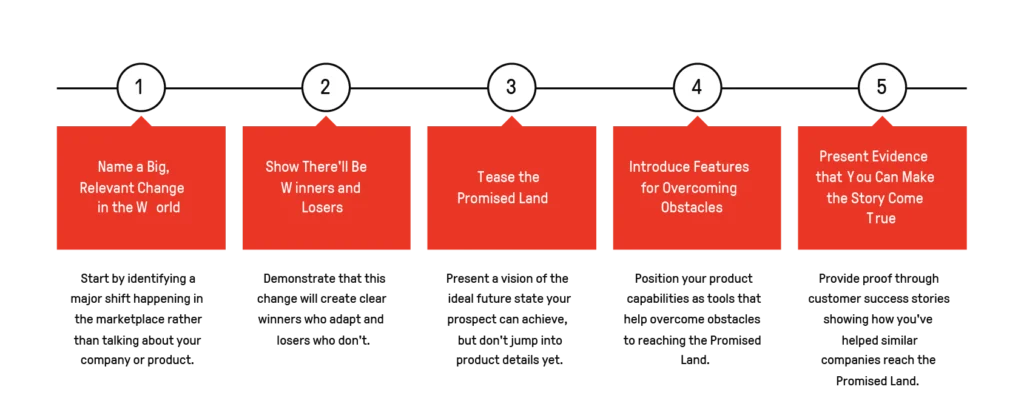
- Opens by naming a big, relevant, and undeniable shift in the buyer’s world
- Shows winners and losers to create urgency through loss aversion and desirability
- Teases a promised land that is improbable without the brand’s guidance
- Introduces features as magic gifts that help the hero overcome obstacles to the promised land
- Closes with evidence last, after the story has already been believed
Key Features
- Five-step framework optimized for leadership alignment and high-stakes pitch narratives
- Built around the concept that CEOs must inspire both their own team and the organizations they sell to
- Deep expertise in venture-backed and enterprise-scale go-to-market narratives
- Highly selective engagement model working directly with CEOs and senior leadership
- Engagements start at $100,000 and above
Where It Falls Short
Raskin’s framework is built for high-stakes leadership conversations, not the day-to-day copy a growing team lives in. It doesn’t include the simple messaging that a sales team, an email sequence, or a piece of collateral needs, and it doesn’t come with a research process for testing which specific language actually resonates with buyers. For companies whose real gap is having an easy story rather than a leadership narrative, Raskin’s model overshoots what the problem calls for.
Learn more about Andy Raskin’s Strategic Narrative.
April Dunford’s Obviously Awesome Framework
Best for: B2B tech companies that need to nail their positioning before building the messaging around it.
April Dunford spent 25 years as a repeat VP of Marketing at a string of venture-backed startups before moving into consulting in 2015. She’s the author of Obviously Awesome, now considered the definitive book on B2B product positioning, and has since worked with more than 200 companies, from early-stage startups to Google and Epic Games. Her work goes beyond the homepage itself by helping companies figure out what to say before copy gets developed.
“As CEO one of the most important jobs is to help articulate your company’s point of view into a compelling story. We went on this journey with April and it transformed our business.”
— CEO, B2B Tech Company
How HE Helps Your Messaging
- Identifies the competitive alternatives buyers are actually comparing the product against
- Uncovers the unique attributes the product has that those alternatives lack
- Defines the value those attributes create for a specific set of buyers
- Determines the target customer characteristics that make the product an easy yes
- Places the product in the market category that makes its value obvious
Key Features
- Five-component positioning framework: competitive alternatives, unique attributes, value, target customer characteristics, and market category
- Built for B2B tech companies with complex products in crowded markets
- Designed to be completed collaboratively with the full leadership team
- Intensive workshop format, typically spanning several days
- Consulting engagements priced between $80,000 and $100,000 for larger organizations
Where It Falls Short
Dunford’s methodology produces exceptional positioning clarity, but the engagement ends there. It doesn’t extend into the emotional story that makes a position land in the room, the sales conversation, or the broader narrative arc a buyer moves through during a long, multi-stakeholder decision. It’s most valuable as the strategic groundwork underneath a narrative engagement built on top of it.
Learn more about April Dunford.
FletchPMM
Best for: Early-stage B2B SaaS companies that need a homepage rebuilt around a clear position, fast, and don’t need a multi-day workshop to get there
FletchPMM is a product marketing consultancy founded in 2021 by Anthony Pierri and Robert Kaminski, built around a two-week, four-call sprint. The sprint runs a structured intake across the client’s website, demo, sales calls, and competitors, then generates four to six distinct positioning strategies, ranked by risk, before locking in one direction. That direction gets documented in a six-slide internal deck and translated into a homepage wireframe with production-ready copy, priced by company stage: $10,000 for early-stage companies under $2M in revenue, $20,000 for growth-stage companies, and $30,000 for mature companies over $20M.
“Fletch gave us the fish and taught us to fish. It was the most important investment to find message-market fit. Not only did we get a clear message, but also a framework that let us rapidly iterate as we searched for the right message.”
— Founder, B2B SaaS Company
How It Improves Your Positioning
- Runs a structured intake across the site, demo, sales calls, and competitors to surface exactly where the current positioning is breaking down
- Generates four to six distinct positioning strategies, ranked by risk, instead of committing to the first idea that sounds right
- Locks positioning to four foundational questions, what the product is, who it’s for, what it replaces, and why it’s better
- Documents the chosen position in a six-slide internal deck the team can reference beyond the homepage
- Ships the position directly into a homepage wireframe with production-ready copy within two weeks
Key Features
- Two-week, four-call sprint founded by Anthony Pierri and Robert Kaminski in 2021
- Tiered pricing by company stage, $10,000 to $30,000 depending on revenue
- Deliverables include four to six ranked positioning strategies, a six-slide positioning deck, and a homepage wireframe
- By design, doesn’t include customer interviews, relying instead on the client’s existing knowledge of their buyers
- Anthony Pierri ranked the top product marketing voice worldwide by Favikon
Where It Falls Short
FletchPMM is built to solve one problem fast, a homepage that doesn’t clearly say what the product does. It deliberately skips customer interviews, which keeps the sprint quick but means the positioning it produces reflects the client’s existing read of their buyers rather than anything tested against real conversations. And because the deliverable is a homepage and a slide deck, the positioning doesn’t automatically travel into the sales deck, the customer success handoff, or the language a rep uses on a call. Once the two-week sprint ends, there’s no mechanism to keep the positioning consistent as the market, the competition, or the product changes.
StoryBrand

Best for: Small businesses, early-stage companies, and brands with a straightforward product and a short sales cycle looking to establish clear, customer-centric messaging quickly.
Donald Miller introduced the StoryBrand framework in his 2017 book Building a StoryBrand. It operates on the principle that customers buy the products they can understand the fastest, and its seven-part narrative sequence has helped thousands of small businesses clean up their homepage, remove jargon, and center their messaging around the customer rather than themselves.
“StoryBrand forced us to stop talking about ourselves and finally start talking about what our customers actually care about. For a small business, that shift was significant.”
— Founder, B2B Services Company
How It Builds Your Narrative and Puts It to Work
- Follows a seven-part sequence: Character, Problem, Guide, Plan, Call to Action, Failure, and Success
- Keeps the customer as the hero and positions the brand as the guide with a clear plan
- Strips away corporate jargon and creates immediately scannable messaging
- Designed for direct application to homepages, email funnels, and landing pages
- Provides a self-serve BrandScript template teams can complete independently
Key Features
- Seven-part fill-in-the-blank BrandScript framework
- Widely available through the book, online courses, and certified guides
- Fast to deploy with immediate application to marketing collateral
- Large community of practitioners and certified StoryBrand guides
- Accessible pricing starting at $275 for the book
Where It Falls Short
StoryBrand compresses a brand’s value into its most transactional form, which works for simple products and short sales cycles but leaves the strategic value invisible for complex B2B companies with long buying processes and multi-stakeholder decisions. B2B buying decisions now involve an average of six to ten stakeholders, each arriving with different priorities and definitions of value, a complexity that a seven-part homepage template was not designed to navigate. It does not produce internal alignment across sales and marketing, does not differentiate from competitors within the story itself, and does not include the coaching or change management required to get a full organization telling the same story consistently.
Choosing the Right Framework
PitchMaps is the right choice if you’re drawn to the Villain and Rally Cry construct and want marketing-ready deliverables built around an emotionally resonant core message. For every other situation, the right alternative depends on what the organization actually needs:
- Villain & Rally Cry Messaging: PitchMaps
- 1:1 coaching and consulting: Andy Raskin, April Dunford
- Positioning for innovative products: April Dunford, FletchPMM
- Helping the founder simplify their story: StoryBrand
- Emphasis on rapid execution and assets: FletchPMM, PitchMaps
- Aligning a complex organization across every channel: Woden’s StoryKernel
If you are a strategic B2B leader whose product requires the market to think differently about an existing problem, whose team is not telling a consistent story, or whose brand is losing deals to competitors with a lower price and a similar pitch, the StoryKernel is built exactly for you.
More than 300 B2B brands have used their StoryKernel to win more best-fit buyers for less. Want buyers to understand what makes you different?
Not clear on your value? Let’s show you how the StoryKernel will fix it. Woden will record a four-minute video with three actionable storytelling ideas for your brand today.